
Bon Appetit, Your Majesty delivers a fun cooking competition in Kdrama form / By Carl Ackerman (Fall 2025)
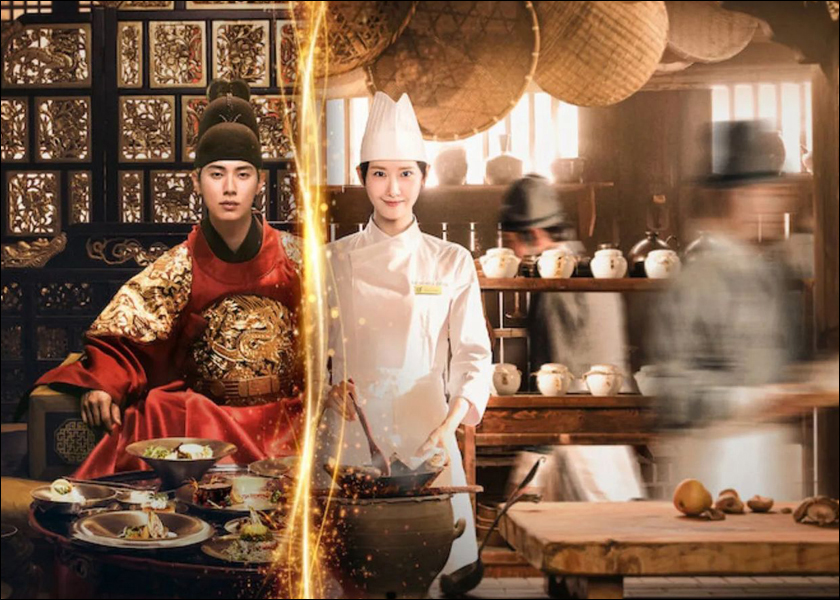
In a celebratory mood, chef Ji-yeong Yeon (Yoon-ah Im) celebrates her victory in a cooking contest, delivered by her French culinary team. In a good mood, Ji-yeong is on a flight back to Korea from France, planning to visit her father, with a solar eclipse taking place outside the plane window. She takes a historical text, originally given to her father, to the bathroom as it has been drenched accidentally by a passenger during the meal service on her flight.
This is the set-up for something strange to happen. The plane bathrooms are very small, there are weird flushing sounds, blue-stained water; they are spooky and are the absolute terror of those of us who are bigger than five feet tall and weigh more than 100 pounds.
The words of the historical text, labeled Mangunrok, creates a special shattering of time (you know, that Einstein thing?), and, well, suddenly Ji-yeong is in the Joseon Dynasty. After a bumpy landing in a forest, Ji-yeong quickly encounters Joseon King Heon Yi (Chae-min Lee), and after a brief struggle, this couple, in the midst of a fight, complete with bows and arrows, plunge off a cliff to the river below, and somehow make it to the river bank unharmed. Ji-yeon thinks she is on a movie set with a loony actor, and Heon Yi is perplexed by the insolence of this strange creature.
It takes awhile until Ji-yeong realizes that the man she saves, captures and then releases is really the king, and that she is in another time. She is taken prisoner and transported to the palace from which Heon Yi rules. The king is subject to the whims of his grandmother, Grand Queen Dowager Inju (Yi-sook Seo) and to the king’s fourth and favorite concubine Mok-ju Kang (Han-na Kang), who also wields a lot of power.
Both women will challenge Ji-yeong’s presence and stature, but through Ji-yeong’s masterful meals for the King, even when he was briefly her prisoner when she first arrived, she is appointed to be head palace chef. Her powers over food, and her 21st century terminology are so strange, many times she is referred to as a gwinyeo (ghost), and thought to be some sort of mystical entity that could be dangerous. The real adversary in Bon Appetit, however, is the villainous Prince Je Son (Gwi-hwa Choi). He has a creepy bad-guy laugh and wields a bloody sword in an eventful coups d’etat.
Nevertheless, what drives the plot is that King Yi becomes smitten by Ji-yeong’s dishes, not only by the new spices, flavors and delicate arrangements of each plate, but by the psychological mood these meals inspire in him, reminding the king of his childhood with his kindly mother, who was disgraced and sent into exile. A Freudian scholar would go mad with the implications here.
Still, the true non-edible delight here is that each episode of Bon Appetit’s 12 segments is named after either a prepared food that is featured in the episode or by something critical to the cooking process: Gochujang Butter, Sous Vide Cuisine, Haute Cuisine, Spanish Doenjang, and so on. The viewer begins each of the 12 segments of Bon Appetit as if walking into 12 new restaurants advertising their main dish or favorite cooking method.
Bon Appetit can be described as a fierce and complex kingly succession story (there are many of these among Kdramas — this one really only gets serious near the end) meets Iron Chef Korea. A very interesting feature is that these cooks do their work without electricity, gas stoves, or refrigeration.
A critical cooking contest takes place over three episodes after a delegation from Ming China brings three cooks with them to the capital city to spare the Chinese officials the perceived inadequacy of Korean cuisine during their stay. King Yi is offended by their presence and calls for a competition of Korean versus Chinese cuisine. The Imperial envoy Kun Yu (Hyung-mook Kim) is an arrogant representative of the powerful Ming; his outbursts are mostly comical and tyrannical, which provides comic relief for the series.
Chinese gourmet cook Chef Bai Long Tang (Jae-joon Jo) steals attention with his majestic long white hair and his scrupulous adherence to the rules of a contest that could bring the Ming much more booty from Joseon. Chef Tam’s niece Xiu Ya Fei (Seung-yoo Moon) cheats when she steals the critical chili peppers that the Joseon cooks, led by Ji-yeong, depend upon for the contest.
Gongs sound and weird metallic time-clocks with fuses swing, putting additional time pressure on all the cooks, as failure could mean anything from critical remarks, to banishment or death for contestants on both sides. Food contest tension is a constant theme in this screenplay, and it works well as a device that keeps the stakes high and the viewer guessing.
The cinematic close-ups of the lips and mouths of all the major players as they eat is a strange technique in this Kdrama. When people eat, what they experience in taste may be accompanied by fireworks on screen, with explosive blasts; or by graphic stars, lights and other visual effects. Sometimes characters with full mouths are transported to an idyllic scene – a lake, ocean, flowery field, etc. The way savory food is recognized and celebrated is a fun part of Bon Appetit.
The scope and magnitude of such cinematic interjections become normal for the viewer. With this eatery bedlam going on throughout the production, one always leaves the show hungry, or perhaps, in my case, stopping the taped show ( the wonders of modern TV watching in the 21st century) to find a snack.
An underlying tension in Bon Appetit, not directly related to food, is protagonist Ji-yeong’s quest to get back to the 21st century. She believes she needs the historical cookbook, the Mangunrok, which was lost when she argued with Heon-Yi and both plunged into a river. The mystical text tumbled down with the two, but fell into a tree. Ji-yeong correctly guesses that the book is the gateway to her flight into the past. She last saw it hanging on a tree, and her desire to get it back is a recurring dialogue with King Yi over the series.
The food produced by Ji-yeong produces more than just the king’s culinary respect for Ji-yeong, and their relationship grows by plates and saucers. A delectable story about the magic of great food, Bon Appetit inspires all who value good cooking to learn more about Korean food and to try making the inspired tastes so meticulously crafted and prepared in this series.

