
Composer Texu Kim makes his mark in Minnesota | By Anne Holzman (Spring 2026)
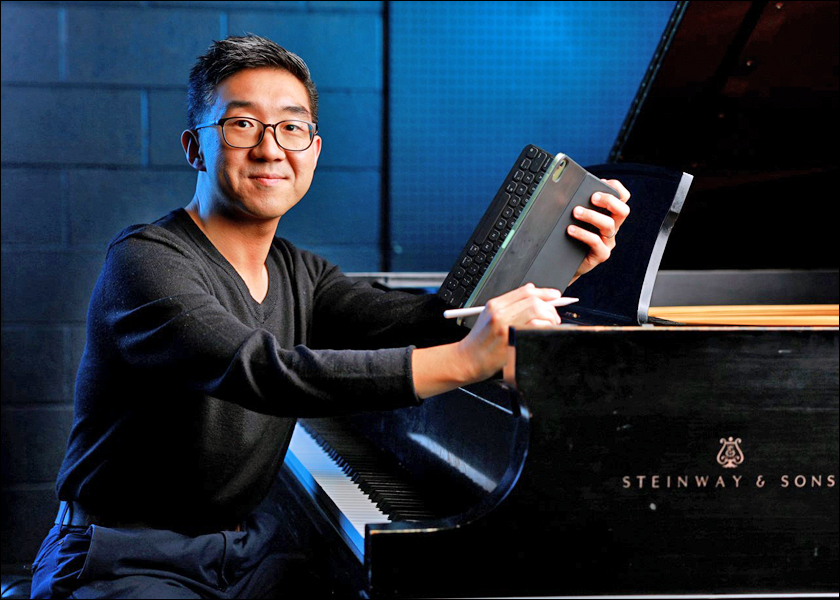
As a composer with a background in Korean folk music, traditional Christian hymns, classical works, and many modern experimental techniques, Korean American composer Texu Kim has been building a following in Minnesota.
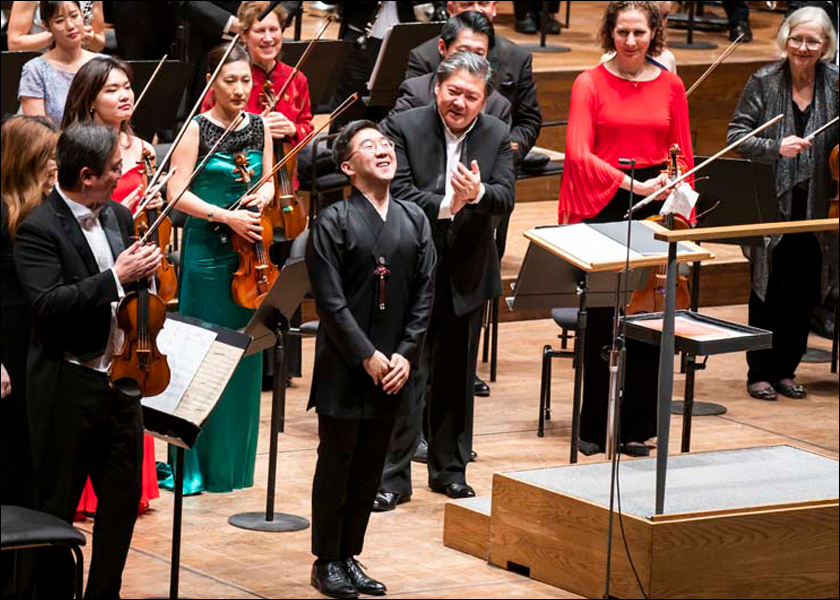
His arrangement of Hong Nan-Pa/Spring in My Hometown was performed at the Minnesota Orchestra’s Lunar New Year concert on February 26. Now he is working on a chamber piece in honor of Kyu-Young Kim (past artistic director and principal violinist of the St. Paul Chamber Orchestra). The piece was commissioned by the Schubert Club.
The violinist will perform the new work with his son Orion Kim at the piano and his wife, Minnesota Orchestra cellist Pitnarry Shin, and violist Misha Amory. Their concert opens the Schubert Club’s 2026-27 Music in the Park series, on October 11 at St. Anthony Park United Church of Christ in St. Paul.
Texu Kim also collaborated with cellist Matt Haimovitz on a short, playful cello solo; Haimovitz recently joined the faculty of the University of Minnesota and continues to develop the Primavera Project, a series of 81 commissioned works from diverse North American communities, to which Kim has contributed.
Kim has trod an unusual path to his recent musical composition specialty, contributing works in an avant-garde strain of European art music. As a child in Korea, Kim said he attended daily evangelical church services with his mother and studied piano and violin. After a successful academic career in chemistry, an encounter with internationally-known Korean composer Unsuk Chin opened the door for him in developing a new career in experimental music.
Texu Kim was born in 1980 in Seoul. His mother was a devoted church member and sang in daily services. He started piano lessons at age four, and almost immediately could pick out hymn melodies from memory. He started violin lessons at age eight. In his teens, he served as a church accompanist.
In an interview with Korean Quarterly in late March, Kim described his mother’s religion as Korean Protestantism mixed with shamanism – a combination that has influenced his compositions. His generation grew up admiring international opera star Sumi Jo and other successful Koreans in the classical music world, but he listened mostly to popular music and jazz.
His family was not wealthy, so Kim did not view a musical career as a practical choice. He was a successful student, especially in science, and won a spot in a science magnet school. In 1998, as a high school senior, he won a silver medal at the International Chemistry Olympiad in Melbourne, Australia.
Kim enrolled at Seoul National University (SNU) to study chemistry, but since he had taken accelerated studies in high school, he had time to continue pursuing music on the side.
He was still playing piano; his idol at that time was French jazz pianist and composer Claude Bolling, whose music he transcribed and played. For a time, he devoted himself to Christian worship, even studying to be a minister. He created albums in the “praise and worship” vein of the early 2000s.
He studied Spanish and considered going to Mexico, but his mother objected, so instead, he took an opportunity to live in Paris. To pay his way, he taught Korean teenagers living there who needed extra classes in order to pass the strenuous standardized exams required by the South Korean academic system. He connected with other expats there, became involved in the European music scene, and began to consider that he could “make an impact” as a musician, he said.
Back at SNU, he enrolled for a second undergraduate degree, this time in music composition. That is where he met composer Unsuk Chin. “I was very lucky that I got to meet her,” Kim said. “She’s a very strict teacher. But she gave me a few critical opportunities in career advancement.” He continued on for a master’s in music at SNU.
Kim considered going back to Europe for doctoral studies but decided instead to explore music in the U.S. He landed a teaching assistant post at Indiana University and earned a Doctor of Music (DM) degree, a specialized degree focusing on composition, conducting, performance and music literature.
Kim has composed for solo instruments, symphony orchestras, keyboard, choruses, and traditional Korean ensembles. His uses a wide range of musical genres, from Korean folk songs to Western modern-era tonal chord progressions; he adds in some wildly experimental techniques played on traditional instruments. “I am an omnivore when it comes to styles,” Kim said.
This flexibility shows up in Kim’s variation on America the Polarized, which starts off like a classical piano sonata, wanders into jazz territory, and as a solo piano piece leaves a pleasantly melancholic echo. Overlaid with the strings, the eerie avant-garde dissonance sounds more like a war is brewing. The score includes a piano part that seems conventional and string parts full of unconventional sliding harmonics and hand slaps. Performers have recorded both versions, to very different effect. “I think that piece represents me fairly well,” Kim said.
Composers live by commissions, and Kim, who is also an associate professor at San Diego State University in California, has drawn a steady stream of projects in recent years. He said the commissioner often requests melodic material or a stylistic tradition that may require him to do some research.
For Sumi Jo’s Libera album released in 2011, Kim arranged themes from George Bizet’s famous opera Carmen into an 11-minute solo backed by orchestra and chorus.
A commission from the PyeongChang Music Festival and School in 2017 resulted in Fanfare for PyeongChang, a spirited mashup of popular song rhythms, traditional Korean melodic material, and brass fanfares, woven together for a symphony orchestra. Kim said that when he draws on Korean folk music, he tends to use abstractions from it rather than quoting directly, in the manner of composer Béla Bartók, who integrated Eastern European folk melodies and structures into his classical compositions.
Kim’s most innovative works tend to be short, compressed, virtuosic, and challenging to the ear of anyone steeped in the tradition of Western classical music. He falls in with the avant-garde tradition that reaches back at least a century, to when Erik Satie and Claude Debussy were looking for pathways out of the maxed-out harmonic world of late Romantic compositions. The avant-garde tradition (or anti-tradition) has produced everything from an exercise in complete silence, by John Cage, to countless exercises in shattering noise involving experimental techniques and modified or electrified instruments.
Avant-garde composition has in turn produced networks of instrumentalists who use classical instruments – sometimes modified with new parts or electronics – to produce unconventional sounds based on unconventional notations. Many classical compositions use these techniques occasionally, but the avant-garde world makes entire works out of an expanded range of orchestral timbres.
Following Unsuk Chin’s lead, Kim found himself among these instrumentalists, mainly in Europe. “Our time requires a different type of sound,” he said. Word of his composing began to spread, and as it turned out, he said, “I was good at it.”
Kim explained that the typical avant-garde ensemble looks like a slimmed-down symphony orchestra, with only one or two representatives of each string instrument instead of the conventional sections. String techniques include complex harmonics (in which a player touches a string lightly to produce extremely high pitches), glissandi (a technique of fingers sliding up and down the fingerboard), bows or hands slapping strings or wood, and variations on pizzicato (plucking strings). Wind players might blow into their instruments, click their keys, or slide around on a pitch. Percussion is more varied and prominent than in earlier eras of composition.
Avant-garde music has also taken advantage of the Internet for production and distribution, sometimes mixing a variety of art forms and including live and even participatory music sessions in connection with a project. Matt Haimovitz, the Grammy-nominated cellist, commissioned a short work from Texu Kim to fit with his Primavera Project, a collection of 81 short compositions from different composers inspired by Sandro Botticelli’s famous painting titled Primavera, and further interpreted by Texas artist Charline Von Heyl’s painting Primavera 2020.
Kim’s contribution, Beseeching, was written for four cellos; during the pandemic of 2020-21, Haimovitz recorded all four tracks by himself. Beseeching is in Primavera Part II: The Rabbits. The Primavera Project was featured in the 59th Venice Biennale Arte and also includes live theatrical events. The project will culminate in a box set of recordings while unfolding in many directions online.
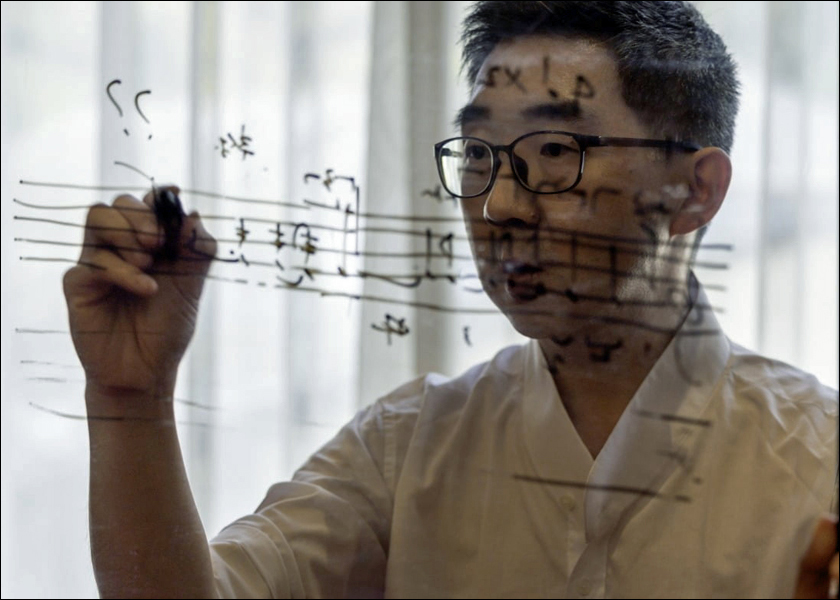
So, what can we expect from the Schubert Club commission premiering next fall?
As of late March, Kim said, he had sketched out a piano quartet in three movements and had a preliminary plan for a fourth. “It was clear that this piece should be something about the family,” he said. He asked the family about their formation as the Shin-Kim Trio during the pandemic, and what they were working on then. A “theme song” for them was the slow movement of the Schumann piano quartet that will also be on the program in October.
Texu Kim said the first movement evokes feelings from the pandemic; the second movement is about the son going away to college and the parents missing him but also wishing the best for him.
Kim was working on the third movement out in California when he began to hear the news about the Operation Metro Surge immigration enforcement action going on in Minnesota. He said he called to check on the family, then shifted his composition approach to reflect on the trauma playing out in the Twin Cities.
He said the fourth movement will be “happier,” and that all four movements will be played attacca (a presentation technique of no breaks between movements).
Kim said that while he’s comfortable with avant-garde sounds, he remains rooted in his childhood experience of listening to hymns, pop and jazz. “Even though my personal taste is quite avant-garde,” he said, “there should be something for everyone to enjoy.”
Editor’s note: Below are some links to hear Kim’s compositions, and a link to news of the Shin-Kim piano quartet performance:
Texu Kim’s website, with extensive performance links: https://www.texukim.com/
America the Polarized piano solo https://www.youtube.com/watch?v=vHTQ2jUmCro
America the Polarized piano quartet https://www.youtube.com/watch?v=aHLqOZUIfEY
Fanfare for PyeongChang https://www.texukim.com/works/fanfare-for-pyeongchang
Primavera Project (Matt Haimovitz) https://www.theprimaveraproject.com/
Sumi Jo, Gypsy Carmen https://www.youtube.com/watch?v=1i4SDWDV6HA
Schubert Club Music in the Park series https://schubert.org/event/shin-kim-piano-trio-with-misha-amory-viola/


