
How one art collection heals the soul and informs us of the steady influence of Buddhism throughout Korea’s history | By Robert Turley (Summer 2026)
So great is the presence of Buddhism in Korea that it is impossible to discuss Korean history and culture without considering its influence, including on Korean art.
Buddhism has a unique place in Asian history as the single shared experience of most people living on the continent. No other cultural influence comes close to the degree to which Buddhism has affected Asian history and culture. Before the emergence of communism in China, Buddhism was the largest religion in the world.
In Korea, 23 percent of the population identifies as Buddhist, yet over 70 percent of the country’s national treasures are Buddhist artifacts. These treasures are designated by the government and officially recognize Buddhism’s influence on Korean culture. Even non-Buddhist Koreans follow many customs of Buddhist origin and remain influenced by Buddhist philosophy, even in their practice of other religions. There is an inextricable link that continues to shape Korean culture and art today.
My father, a Southern Baptist minister, had an open-minded attitude toward learning from other religions and cultures. To him, Buddhist art was so beautiful he felt it surely must be imbued with deep spirituality.
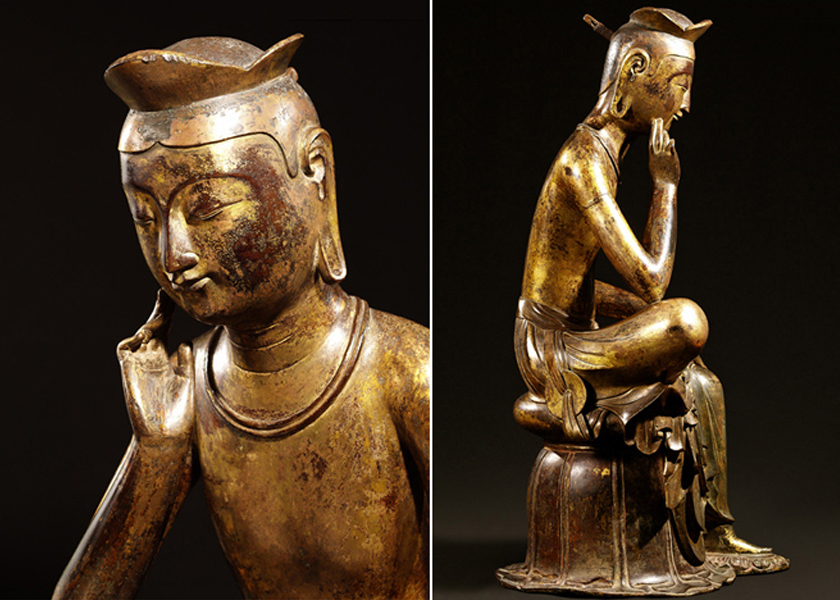
I recall sharing many images of Korean Buddhist art with my dad, and talking about how extraordinary it is. I remember in particular the deeply contemplative Pensive Boddhisatva (Korean National Treasure number 83), one of the most beautiful works of Buddhist art in the world.
It is not only a technical accomplishment, with its advanced bronze casting methods, it is a supreme artistic accomplishment. At a time when more ornate Buddhist sculpture was predominant, the artist conceived a bare-chested and barely adorned Boddhisatva. Stiff formality is abandoned for a posture that is natural and relaxed. The soft curves add to the feeling of calm and the slight bend forward draws one in to partake in the subject’s contemplation. The folds of the lower garment do not follow the schematic of Buddhist sculpture. Instead, they flow in undulating waves of varying shape. The hint of a smile we so admire on the Mona Lisa appears here in serene satisfaction a thousand years earlier. This type of naturalistic rendering was influential on later works in both Korea and Japan.
The first time I saw the Pensive Boddhisatva, also known as the Gilt-Bronze Maitreya in Meditation, my shoes became glued to the floor and my eyes fixed to the sculpture. Nothing before had whispered to me so clearly, “Hey, stop and think. No, I mean really think, and feel. I mean examine, contemplate, and consider.” The Boddhisatva then invited me to unglue my feet and circle it to appreciate its fine artistry from every angle. It was an unforgettable and inspiring experience.
When the soul needs some exercise, a trip to the third floor of the National Museum of Korea can provide it. There one will find the Buddhist Sculpture Gallery, which always provides a healthy dose of inspiration.
This is the home of the Pensive Bodhisattva in its thoughtfully designed Room of Quiet Contemplation. Other examples of what makes Korean Buddhist art sublime await observation and appreciation in the surrounding galleries.
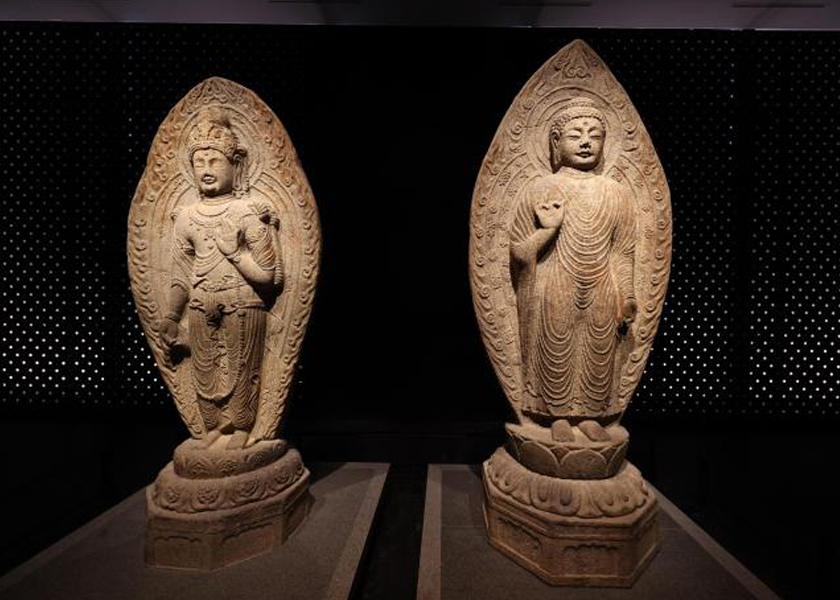
A contrast to the Pensive Boddhisatva is the imposing grandeur of the Iron Buddha, the largest of its kind. The Stone Buddhas of Gamsansa Temple has paradoxical and mysteriously soft renderings in the hardest material, granite. And of course, there is no missing the 10-story Gyeongcheonsa Pagoda on the first floor of the museum.
Exploring this museum gives the viewer a new eye toward influence of Buddhist art throughout the centuries in Korea. It is often subtle, and sometimes overt, but it is a constant thread throughout history.
The National Museum’s collection can be viewed online, which is a great opportunity for those who cannot make the trip. It is, of course, not the same as viewing the works in person, but it is enough to plant the seeds of wonder and exploration.
As an author and musician, I am always looking for inspiration. Of course, I can find it in literature and music. But sometimes I need to look beyond books and songs to find unique stimuli that help me look at the world more deeply and think differently. I often turn to the visual and performing arts to inspire me to see the world in new ways.
Inspiration through art can be helpful in many fields of work. Even in something like business, it is helpful to be a creative problem solver to invent work-arounds for various challenges or to take new approaches to marketing. Studies show that exposure to art can stimulate creativity and help us think more originally.
Many encounters with profound imagination are waiting in museums and galleries abroad and at home. Korean Buddhist art offers more than just innovation to motivate one in their field. Most importantly, engagement with the visual arts celebrating this ancient and practical philosophy provides encouragement for living a complete life full of wonder and beauty.
(Portions of this article are excerpts from Robert Turley’s upcoming memoir, Inktown.)

