How red ink, ritual and rising water turn memory into warning in Korean horror films | By Titiksha Devrani (Fall 2026)
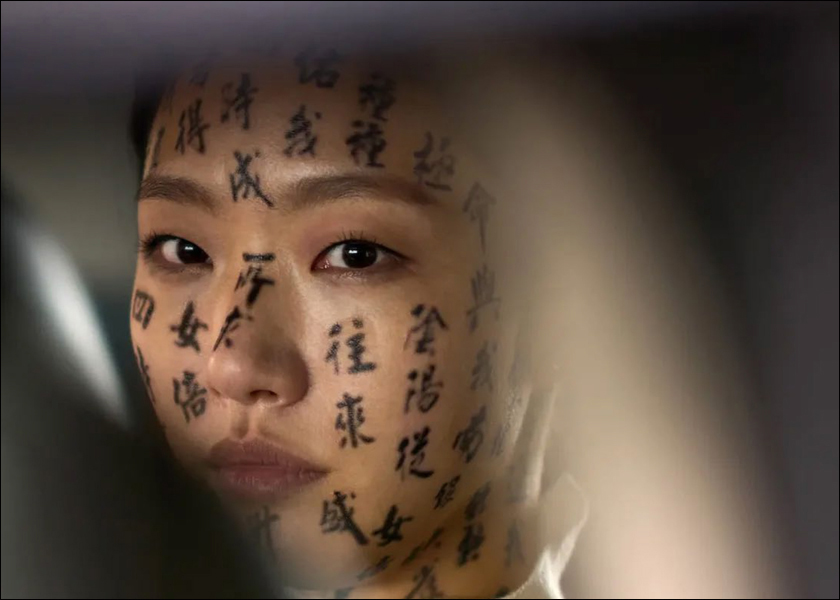
I’ve watched foxes waiting near a grave. Crows turning in rhythmic circles overhead. And somewhere, in a barren stretch of land, an iron spike working its ploy beneath the ground
The first time I watched the Korean film Exhuma, I was simultaneously intrigued and confused by these images. Understanding what these images meant gave the fear a shape, at first.
Red ink is one of these images – in Korea, it is traditionally associated with the dead, and writing a living person’s name in that color can carry a cold threat. When that color appears beside a living character’s name in film, it is meant to be a death sentence.
Some numbers carry a negative connotation as well. For instance, the number 4, or sa (사), is a homophone for the (Chinese-derived) Korean word for death. Korean apartment buildings and elevators sometimes skip the fourth floor entirely, labeling it “F” instead. For those who understand, the 2006 horror film 4 Horror Tales: Hidden Floor becomes that much more relatable.
However, not every recurring image in Korean film carries such a dark meaning. Rain, in Korean dramas, usually means the opposite of dread. For a romantic couple, getting drenched by a sudden rainstorm is a sign of good luck for their relationship. There are often images of two people caught in the rain and forced to share one umbrella while walking home, laughing. The Korean drama Something in the Rain takes its very title from the idea.
Snow toes the line between beauty and danger. A first snowfall is meant to be an omen of change, which can mean both hope or terror depending on the circumstances. The drama Goblin makes use of the image for both a confession of love and a character’s death.
The appearance of red ink, the number four, rain, snow and other symbols in Korean stories do not mean anything on their own. Western horror hands you an explanation as it guides you through the mystery of the haunted house or the past of the possessed doll. Korean horror, on the other hand, uses visual repetition, wherein an image first appears casually and returns later to surprise the audience with the sheer gravity it holds.
I’ve caught myself pointing at my laptop screen while watching a Korean movie, trying to remember where I had seen a particular image before.
This is because memory supplies context in Korean horror. Folklore knowledge can turn an otherwise ordinary detail into a warning, giving a culturally-fluent viewer a richer experience compared to someone not in the know. At least it can have that effect in the hands of certain filmmakers. With others, the horror to be unleashed has no warning system.
The iron spike and the fox den
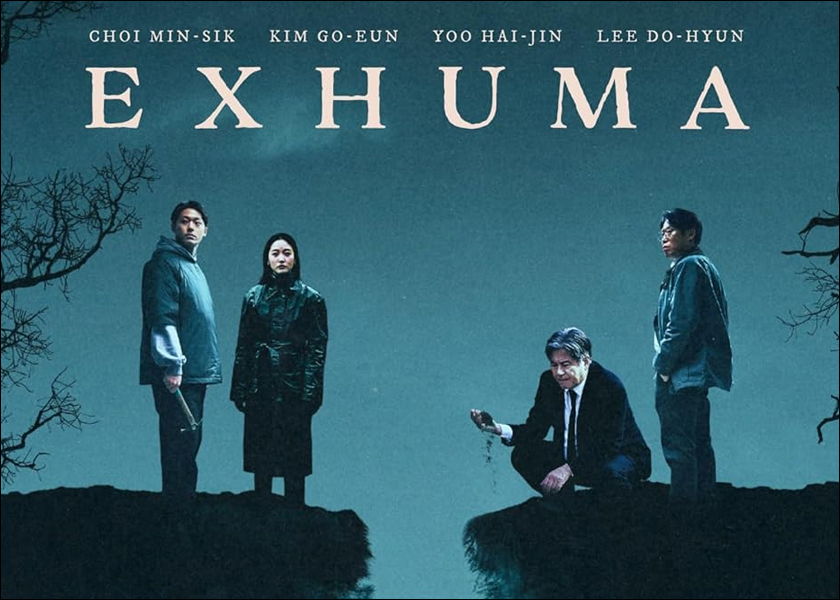
Exhuma is an example of a film where folkloric awareness wills the audience toward an explanation of events. The clues point toward a buried history. An aged geomancer tastes the earth at a grave near the border with North Korea. He frowns. The stone is unmarked, with only coordinates cut into its back. Foxes watch from the surrounding trees. There is a stillness, and the stillness spreads to the audience like a spell.
In the story of Jae-hyun Jang’s Exhuma (2024), a shaman is recruited by a wealthy Korean American real estate developer to identify the mysterious, and apparently spiritual, illness affecting the family’s newborn son. The shaman Hwa-rim decides a vengeful ancestor’s spirit is the cause, and the family’s patriarch enlists the help of Hwa-rim and her colleagues, a mortician and a geomancer, to relocate the grave. A generous fee motivates them to take the job.
Their ignorance is their downfall because the malevolent spirit unleashes a wave of destruction on the living. The unearthing of the grave is linked historically and spiritually to the unearthing of the truth of Korea’s past as an occupied people.
The story is loaded with spiritual clues and portents. For generations, Korean stories warned against burying the dead near a fox den. Foxes are semi-spiritual creatures in the Korean mindset. There are some spirits, such as the gumiho, who can shape-shift to human form; while in spirit form it appears as a nine-tailed fox. Some believe the foxes disturb the grave and can assume the identity of the person interred beneath it.
In Exhuma, , the ground gives up a second casket beneath the first one, wedged completely upright. Inside is a Japanese general. Driven into the earth beside him is an iron spike. For the Korean audience, the scene recalls the still-debated and controversial belief that Japanese colonial authorities drove metal stakes into the peninsula’s mountains to sever its geomantic energy. Incapacitating that energy, in traditional belief systems, would also weaken the Korean people’s energy to unite and defend their native soil from the invader.
Later in the film, the shaman Hwa-rim draws a knife across her thigh and her cheek. She smears ash onto her face. Her eyes close in something between pain and rapture, the drums going the entire time. It is a visceral scene, meant to unearth unease in the viewer. Pigs are sacrificed as substitutes, meant to absorb the bad energy that would otherwise harm a living person. Hwa-rim keeps moving to a rhythm different from the one the drums are playing.
Every one of these clues is foreshadowing, planted early and meant to add up to something the audience can name. I believe Exhuma keeps its promise, rewarding the trust it asks of its audience.
Competing claims on the body
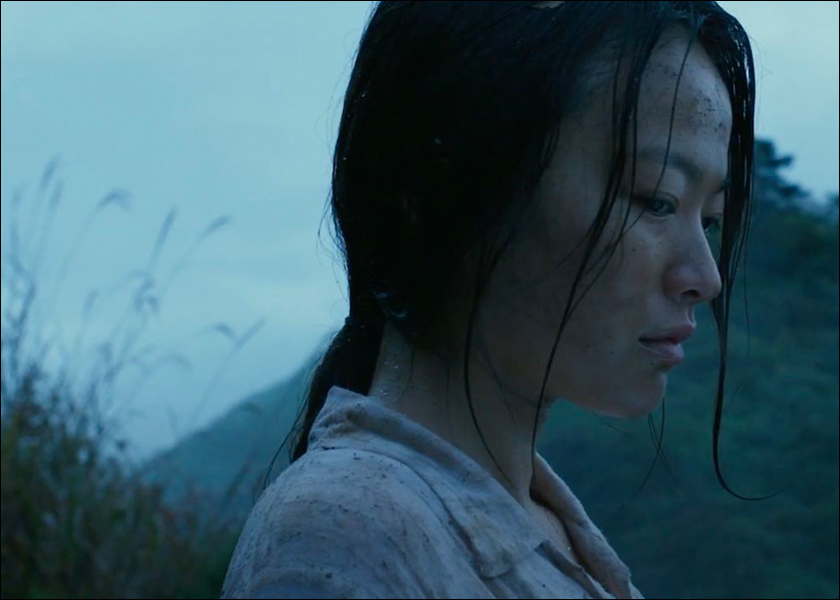
The Wailing (2016), in turn, breaks that promise on purpose, using ambiguity as a match point. The story describes how a mysterious Japanese man settles in a remote mountain village in South Korea. An infection breaks out, affecting the villagers with strange symptoms. They become deranged and violently kill their own families. The story centers around a police officer who is investigating the mystery after his daughter becomes infected.
The film introduces scenes the viewer cannot understand. The shaman Il-gwang, called in to help, arrives in a colorful robe and chants over a girl writhing on the floor. Miles away, another man kneels over his own arrangement of bones and photographs, working the same way with different hands.
I felt unsettled while watching The Wailing for the first time.
There is a helpless feeling in knowing that the signs don’t give you mastery over the horror of the story. Both scenes are clearly rituals, but the viewer cannot tell which one, if either, was supposed to really be happening. The rituals function as competing claims on the same body. While director Hong-jin Na imparts to the audience enough cultural fluency to recognize what’s unfolding, a reliable answer is kept just out of reach of the audience.
If anything, the more we understand as viewers, the more the uncertainty closes in, because we can no longer tell ourselves we are simply missing the context. The Wailing asks for that same trust, then declines to repay it.
Downhill to the semi-basement
A third register exists in Korean horror films, a characteristic that is stranger than the two before. It is one where horror belongs intrinsically to the society, and where the pressure of the rot and injustice spills over and lets loose a kind of social redemption. The famous Joon Ho Bong film Parasite (2019) rents space here, and Bong’s The Host (2006) is also a permanent resident.
There is a role for nature in the resolution of these stories, but nature is not an evil force. It is powerful, yet neutral. In both films, society’s inequitable systems assume the role of the malevolent spirit, while nature becomes a force for redemption.
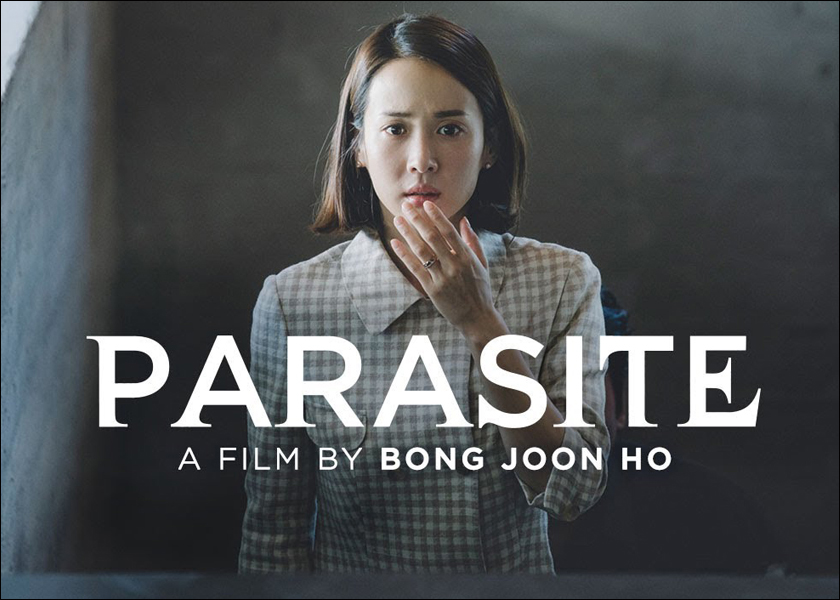
Late in the convoluted story of Parasite, a torrential rainstorm floods Seoul, and there is a long overhead shot of the wreckage. We see whole rooms full of the ruined objects of people’s lives floating loose in the brown floodwater that blurs and evens out the landscape. The shot wipes out the ordinary noise of the city, introducing a quiet horror of resignation.
The Kim family, who have been employed as domestic servants by a family in the wealthy heights above Seoul, descend through the city as the water rises, to the submerged streets of the poor neighborhoods below. They find their semi-basement home swallowed by sewage and floodwater. It’s humbling to see how the same storm that barely interrupts one wealthy family’s evening destroys the homes and livelihoods of so many families in the urban slum. The wealth is positioned above the flood, and the poverty below it. It’s as if the water follows the city’s existing hierarchy downhill.
What the river leaves behind
The Host is a monster movie, in which a creature is created accidentally from chemicals dumped into the Han River by an American military mortician. Ritual and knowledge prove irrelevant here. There is no way a character can read the danger from a fox’s stare.
Rather, the horror is human, systemic and created with bureaucratic indifference made monstrous and let loose into the water everyone depends on. When the creature attacks, it does so in broad daylight, at a riverside park full of ordinary families. There is no genre grammar that cues the audience to brace. The flood comes and takes the rot with it, and what’s left is a ruined landscape that has to be rebuilt.
In each of these four films, something horrifying but distant eventually becomes close and impossible to ignore. Whether it is the emerging horrors of the past that we recognize through folklore or repeated images and symbols as in The Wailing, the wartime horror intruding into the present day as in Exhuma, or a human-caused modern horror, like The Host or Parasite, the audience is paralyzed as evil is upon us. The water rises, and the people with the least are left with nowhere to go.