
Miss Kim Knows and Other Stories ~ By Nam-joo Cho
In a short story collection, Nam-Joo Cho discusses the realities of Korean women’s lives
(Translated by Jamie Chang, Liveright Publishing, New York, 2024, ISBN #978-1-3240-9531-6)
Review by Joanne Rhim Lee (Summer 2026)
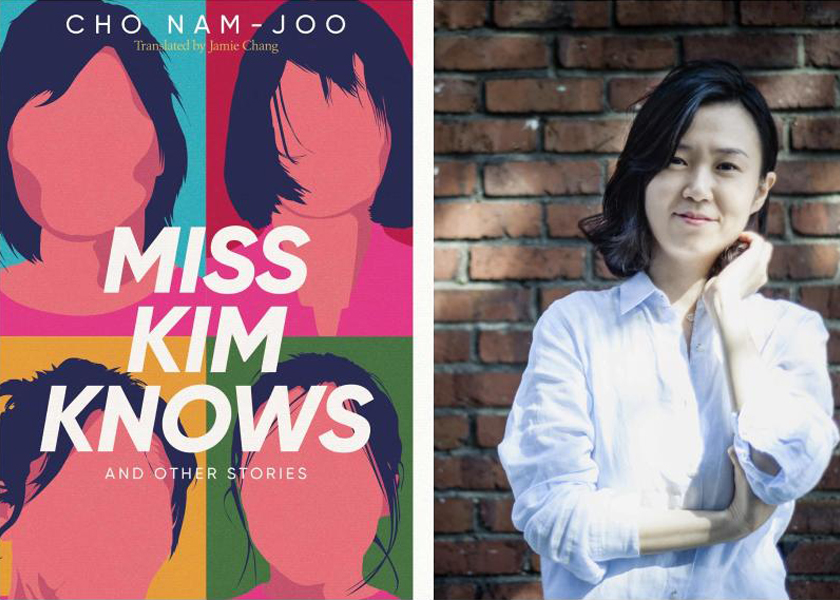
Nam-Joo Cho’s popular novel, Kim Jiyoung, Born 1982, was an international bestseller, and was longlisted for the National Book Award. It was also adapted into a popular feature film. Published in 2016, it is a searing portrayal of a successful young woman who gives up her career to become a stay-at-home mother, and the punishing toll of this decision.
Almost a decade later, Cho has published her first book of short stories, Miss Kim Knows and Other Stories. In eight sharply-observed narratives, the author returns to many similar themes from Kim Jiyoung, such as sexism in the workplace, mental illness, and the unrealistic division of labor among married couples. She also explores the generational divides among Korean women, sexual harassment of teenage girls, as well as aging, illness, and mortality.
One of Cho’s most affecting stories, Dear Hyunnam Oppa, relates a story of one young woman’s personal growth during a 10-year relationship that began in college. Hyunnam Oppa (oppa being a term of endearment used by girls and young women for older brothers, male friends, and boyfriends) was a bit older than the narrator, and had a prestigious job which required him to dress professionally and network constantly.
For his high school reunion, Hyunnam buys her a fancy new outfit and books a salon for her to get her hair and makeup done, even though she rarely wears makeup. The narrator relates how uncomfortable she was with this makeover, and how she finally tells him she would rather go just as she was, in her own clothes. He was furious, and gaslit her, asking if her feminist friend had put her up to it.
Still, the relationship continued. There were also very helpful things that he did when she lived alone in Seoul, away from her parents. He took time off from his job to look for apartments with her, he helped her negotiate the rent, put up wallpaper, and did minor repairs, even though she was quite capable of doing them by herself, having grown up with a handyman father.
In one conversation, Hyunnam Oppa told her he wanted her to have a stable job with regular hours so she could be home and available when he was done with his own (very taxing) job. He told her that she would make an excellent librarian, and put her on a strict study schedule so that she could pass the library science exam. Though she wanted to take breaks, he brought her kimbap so that she could eat dinner quickly and go back to studying. When they did go out, he would gaze lovingly at little children, and would tell her he wanted at least three children. He never asked her how she felt about children.
This story is written in the form of a letter to him. It recounts the details of what happened during the relationship, and is an airing of the narrator’s true feelings that she repressed over the years. It’s a powerful manifesto for all the women who have been squeezed by others into a box they did not fit, or made to walk a path they did not choose.
In Grown-Up Girl, a popular and studious boy is accused of sexually harassing a girl at his school, and is in danger of being expelled. His mother immediately shifts into damage-control mode, asking the mother of a female classmate who witnessed the incident to vouch for her son. This mother suffers from severe migraines, and doesn’t want to get involved. What is the truth when it comes to sexual harassment? Is it black and white, or can it be gray?
In Night of Aurora, a middle-aged daughter takes her almost 80-year-old mother-in-law to Yellowknife, Canada, to see the aurora (northern lights). It’s not guaranteed that they will see the aurora, but there is a high chance of it (98 percent) with the four-day package she chose. Both women were widowed at a young age, and both were overworked and unappreciated their entire lives, taking care of their own young children and later their grandchildren.
The issue of childcare in South Korea is a fraught one; many young mothers want to pursue their careers, but to accomplish motherhood and career simultaneously is risky since there are very few childcare options. Many women enlist their mothers or mothers-in-law to take care of their children full time, knowing that it is difficult, exhausting, and usually unpaid work. This is a beautiful, heartbreaking story of the aurora, and describes the predicament of so many women who spent their lives caring for children and grandchildren they never asked to raise.
Cho is a master of wry social commentary, along the lines of Jane Austen. She seems to have her finger on the pulse of modern Korean women in her crafting of such enjoyable, witty stories, that nonetheless bring forth hard truths in a frank and courageous way.
A decade ago, Cho kick-started a national conversation about gender inequality in Korea with Kim Jiyoung, Born 1982, and this simultaneously charming and incisive book of short stories picks up right where she left off.


