
Renee Good’s murder reminds us that compassion is also a foundation of democracy | By S.K. Lo (Winter 2026)
The recent killing of a young woman by an ICE agent in Minneapolis has shaken our community and raised urgent questions about the direction of federal immigration enforcement. As a Minneapolis area resident who watched the released video, I was struck not only by the tragedy itself but by what was missing: Any clear evidence that the woman posed a threat to the agent who took her life.
She was Renee Nicole Good, a white woman in her 30s, an unexpected victim that shattered my own assumptions about who is vulnerable in today’s climate of aggressive immigration policing.
This incident does not stand alone. Minneapolis has seen hundreds of ICE arrests in recent months, a surge that feels less rooted in public safety concerns and more aligned with political promises and enforcement quotas. The pattern suggests a troubling shift: Immigration raids carried out not because they are necessary, but because they are symbolic. They serve as political theater rather than thoughtful policy.
The consequences extend far beyond Minneapolis. In Wisconsin, Judge Hannah Dugan, who allowed an undocumented immigrant out a side door of her building so he could avoid ICE officers who came looking for him, was found guilty of impeding or obstructing a federal proceeding. Just this month, Duggan resigned from the bench after Wisconsin’s top legislative Republicans announced they would take actions to impeach Dugan unless she resigned “immediately.” Dugan’s attorneys have indicated they intend to file for a new trial.
This example shows how aggressively the political system now punishes even small acts of compassion or discretion. It is hard to avoid the conclusion that the compassionate Americans who once shaped this country’s moral compass are no longer the ones steering its policies.
The issue of undocumented immigration is undeniably complex. People come to the U.S. for countless reasons, including economic opportunity, family reunification, or simply the hope of a safer life. More recently, waves of refugees have arrived because of wars that the U.S. itself has been involved in. Many elder Korean Americans and elder Southeast Asian Americans know this story intimately. Families displaced by conflict, were resettled here, but their children can be later denied citizenship due to bureaucratic gaffs or youthful mistakes.
Some immigrants, including a small number of non-citizen Korean adoptees, are facing deportation to countries they have never set foot in. The cruelty of sending someone “home” to a place that is not home at all cannot be overstated. At its core, this crisis forces us to confront a fundamental contradiction in American identity.
With the exception of Native Americans, every American is descended from immigrants. Yet some immigrants are treated as more legitimate, more deserving, or more “American” than others. This hierarchy betrays the founding ideal that all men are created equal.
And yet, amid the fear and division, moments of humanity still shine through. Renee Good was performing an act of compassion, observing ICE activity and standing up for justice at a time when her non-white neighbors were not able to show their faces for fear of unlawful detention. She was randomly shot, but she was at that place and time intentionally, as an act of love for her neighborhood.
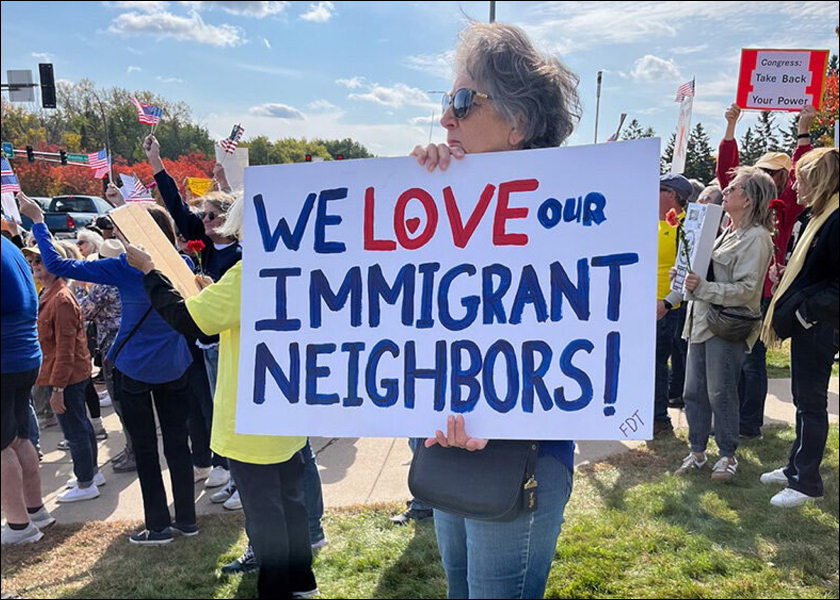
At the recent “No Kings” rally in Minneapolis, I saw a white woman holding a handmade sign that read: “We love our immigrant neighbors.” When I asked her why she made it, she told me she was a third-generation immigrant herself, and so were her neighbors. Her simple message cut through the noise: Compassion is not dead in America. It is simply being drowned out by louder, harsher voices.
The killing in Minneapolis should be a wake-up call. It is time to demand accountability, to question policies driven by politics rather than justice, and to reaffirm the values that once made this country a beacon of hope. Our immigrant neighbors deserve dignity, safety, and the chance to belong. And we, as a nation, deserve leaders who remember that compassion is not weakness. It is the foundation of democracy.

