One Minnesota attorney represents and unites adoptees for human rights and citizenship | By Martha Vickery (Spring 2026)

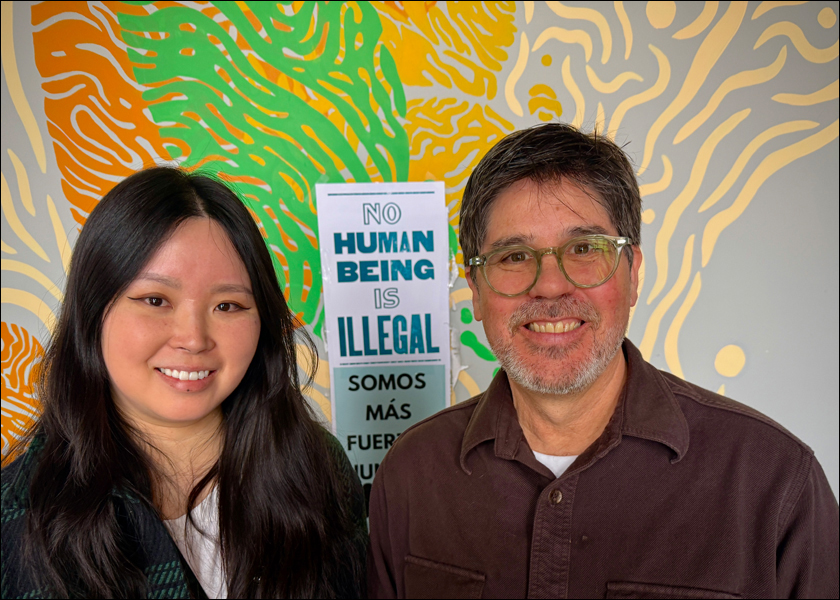
In an atmosphere of fear about the Immigration and Customs Enforcement (ICE) operations in Minnesota, there are only a few legal experts who can authoritatively refute the rumors, call out the illegal and misapplied policies, and provide help with immigration law. One of these experts is attorney Greg Luce, who specializes in issues affecting intercountry adoptees.
Luce spoke about his adoptees-only legal practice during an informational fundraising event at Arbeiter Brewing in Minneapolis, targeted to adoptees and their families and allies. His talk centered on legal remedies for intercountry adoptee adults who, for various reasons, do not have citizenship.
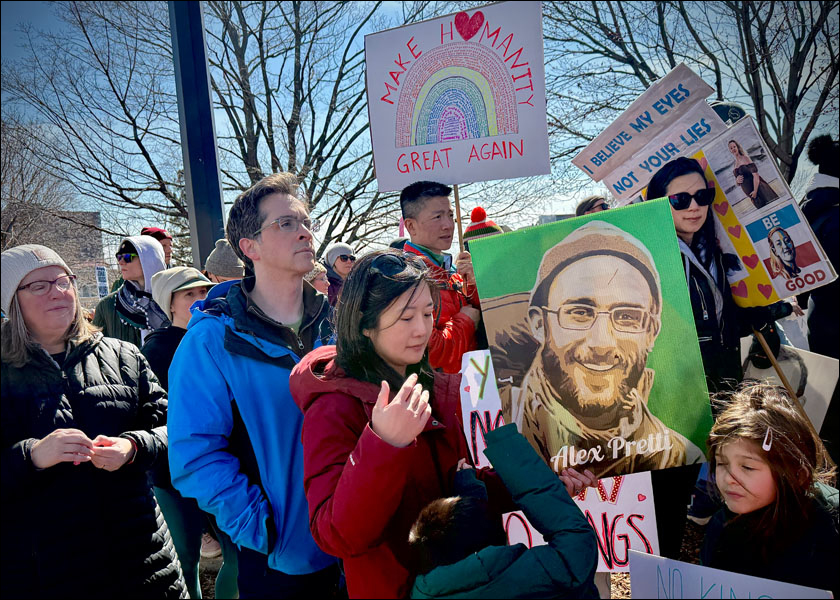
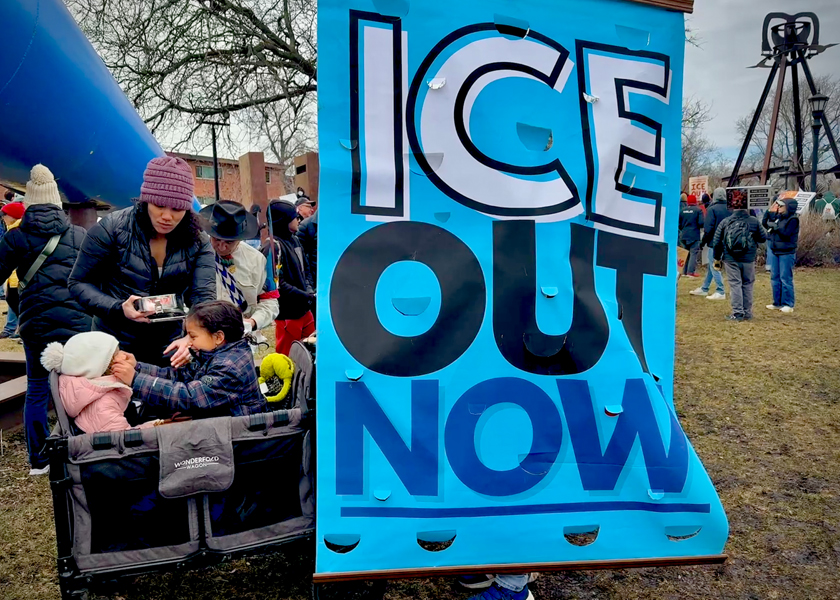
Kira Siegler, president of the co-sponsoring organization AK Connection, introduced the topic and its pertinence to Korean adoptees, particularly Twin Citians who have suffered through the recent Operation Metro Surge sweep of the Twin Cities area (and other locations in Minnesota). It has been a traumatizing time for Korean adoptees, she said. “Our lives have already been shaped by being moved from one country to another, as babies or children, and without having any say.”
With the recent ICE surge as a backdrop, Siegler said, “Today is really a day of naming that reality, understanding it, and knowing what we can do to protect each other, ourselves, and our communities. Resources, education and community are more important than ever before.” The event was also intended to reassure intercountry adoptees “who feel invisible in conversations about immigration issues, although our community is also affected,” she added.

Trauma for Minnesotans
An estimated 3,700 people were arrested and detained during the Minnesota surge, but only 24 percent had any criminal record, and a fraction of those had any pending criminal offense, according to statistics released in March by the Deportation Data Project. An analysis of available data by Sahan Journal showed that 70 Minnesota children were among the detainees, with some sent out of state for detention.
A (yet unknown) number of detainees were citizens, including demonstrators and observers arrested ostensibly for being in the way of (or in the vicinity of) ICE activities, or for being non-white and looking like an immigrant. Anecdotally, Korean Quarterly has learned that least three adult (citizen) intercountry adoptees were among those detained by ICE agents and later released.
The March event was co-sponsored by AK Connection, a non-profit organization by and about adult adopted Koreans in the Twin Cities area, and the national non-profit group Adoptees United. Proceeds benefitted Adoptees United, which covers certain costs related to citizenship-related expenses and provides informational outreach about adoptees’ rights and adoptee citizenship. Adoptees United also supports adoptee advocacy, related to both immigration issues and access to adoption records.

A law practice by and for adoptees
Luce started his practice, the Adoptee Rights Law Center, in 2016, and the non-profit Adoptees United in 2019. He began the practice, he related, after having legal problems getting his own adoption records in Washington, DC, where he was adopted and brought up. His initial idea was to specialize in adoptee records access and to do advocacy for adoptee rights. He credits his wife with supporting the idea and supplying almost all of their income, which allows him do low cost or pro bono (free) work in his adoptee-centric practice and later, to establish and develop the Adoptees United organization.
He was surprised at first, he said, to find out that citizenship was such a big legal issue for the intercountry adoptees he met. To meet that demand, Adoptees United developed the Citizenship Clinic, to provide structure, education, and representation for adoptees seeking legal help to obtain citizenship. Except for certain fees and costs of doing its business, the Citizenship Clinic provides legal assistance on a pro bono basis.
He said he wanted, as much as possible to “take the money out of the equation” so that no intercountry adoptee would have to delay getting citizenship because of cost. “The money raises expectations on both sides. It interferes and also creates barriers for some people who maybe could afford it, but put it off. People really just need to get it done,” he said. “I really think there should be no financial barrier at all.”
His belief in making legal help more accessible began when he worked for a legal aid organization on tenant rights and avoiding eviction; he quickly learned how crucial the timing can be. He is also personally motivated to be of use to fellow adoptees, and “I really love what I do,” he said.
The organizational structure allows Luce to represent those who might otherwise risk the delay of obtaining citizenship. There is also a pay-it-forward tradition; clients who can afford it often later donate to Adoptees United to defray the costs for others, he said.
Particularly in the last year, Luce said, he has been overwhelmed with cases of adoptees whose citizenship was never finalized. His caseload as of March 15 included 215 active and 195 closed cases, a lot for one attorney. Recent stringent federal enforcement has has heightened concern about immigration status, Luce said, and the number of new clients reflects this.
Becky Hanson, a Korean adoptee from St. Paul, told the group how the Citizenship Clinic, and Luce specifically, helped her obtain her own adoption records. Hanson said she was nervous about immigration enforcement back in 2024 even though she is a citizen and has her documentation.
She got all her paperwork together “because information is power and it is another way to add a layer of protection for yourself.” She appreciated the monthly meetings Luce held in 2024 and 2025 because he provided both expertise and reassurance at an uncertain time. Luce also helped Hanson submit a Freedom of Information Act (FOIA) request to obtain her adoption records after she was unsuccessful in getting them on her own.
Luce briefed the audience of mostly Korean adoptees and their family members, friends and allies on why some adult intercountry adoptees are still not citizens, and some of the legal remedies to correct that.
In recent years, he has taken on more adoptee immigration issues because of greater demand. At the same time, there was less demand for his records access services for domestic adoptees. Getting adoption record has become easier in most states, and more would-be clients can navigate obtaining records on their own, he said.
In part, he said, the impetus to expand citizenship-related legal help was motivated by a rule change by the the U.S. Citizenship and Immigration Services (USCIS) to exempt adoptees from the $1,200 filing fee for the citizenship application. Adoptees can apply free now, and “we thought that if we remove the cost of legal, then we have removed the financial barrier to adoptees gaining citizenship.”
There were very few citizenship clients at first, but after November 4, 2024 (the day Trump was elected for a second term) “there were a skyrocketing number of clients very concerned about not having the right immigration documents, especially the citizenship certificate.” Fortunately, he said, at Adoptees United, they had also been anticipating a higher influx of non-citizen adoptees, and had put the Citizenship Clinic structure in place to screen potential clients and efficiently receive them if the applicants’ needs fit the services they can offer.
The role of states in supporting adoptee rights
There are still many states where adoptees have difficulty obtaining their own records. Luce, who is licensed to practice in Minnesota, has been advocating for a Minnesota bill to allow adoptees to get their own adoption records upon request, without a court order.
The Adoptees United website urges voter support for the bill. This bill died in committee during the recent legislative session, but will be reintroduced in the 2027-2028 session. The bill, which Luce wrote, revises an existing law. Adoptees often need to obtain their records, he said, and the requirement for a court order serves no purpose, and is slow. In particular, non-citizen intercountry adoptees routinely need their adoption records to apply for permanent residency or citizenship, Luce explained.
Immigration law and adoptee numbers
Luce trained himself in immigration law, which he calls “one of the most complex law specialties,” realizing quickly that there were “many gaps in the law that leave intercountry adoptees without citizenship.”
When he first started working in adoptee citizenship, Luce said, he researched how many U.S. intercountry adoptees there are, both for his own use in the law practice and to provide documentation to Adoptees United for future grants or lobbying. There was no single source of reliable data. He began with a paper database of U.S. entry visas for intercountry adoptees from 1972 to 1999. Later, he was able to add other data from before 1972 and after 1999, and up to 2023 for some countries.
South Korea, with (at least) 114,472 U.S. intercountry adoptees (by Luce’s estimate), sent the most adoptees to the U.S. in total. The other main sending countries include Russia, China, Russia, Guatemala, Ethiopia and Columbia.
Luce’s total comes to 503,596 intercountry adoptees admitted to the U.S. from 15 countries, which is “probably fewer than the real number, because it counts only those with entry visas. A lot of adoptees also came with tourist visas,” he said.
Why some adoptees are not citizens
Luce detailed why some intercountry adoptees don’t have citizenship. The main reason is inadequate laws. Despite some efforts over the years, the accumulated web of laws and policies related to intercountry adoptee citizenship still does not ensure that all adoptees are citizens.
An existing bill, when passed, would supersede current law and make all intercountry adoptees citizens. However, Congress has delayed for many years passing such a bill. This bill, formerly called the Adoptee Citizenship Act, now known as the Protect Adoptees and American Families (PAAF) Act, would provide automatic citizenship for all intercountry adoptees (in the future and retroactively), including those who have been deported.
Luce pointed out that adoptee citizenship is a much simpler issue than the larger immigration reform agenda, but the debate around immigration has muddied it, causing the bill that would correct adoptee citizenship to be delayed many times. Intercountry adoptees are not just another immigrant group; they are a unique group of people who were children when they legally entered the U.S., whose new families intended them to be citizens, he explained. A clearer, and less political categorization of adoptee citizenship would be to re-brand it more neutrally as “a family policy issue,” Luce added.
Luce also detailed the Child Citizenship Act (CCA), a confusing stopgap bill that became law in 2001. The law gave automatic citizenship to intercountry adoptees who were younger than 18 as of February 27, 2001. “That means Child Citizenship Act has given thousands of adoptees citizenship, but also denies thousands citizenship,” he explained.
The CCA leaves out an estimated 75,000 intercountry adoptees who were age 18 or older on February 27, 2001. “These people are vulnerable to not being a U.S. citizen and may just have a green card,” he said. (Most intercountry adoptees who have been deported were permanent residency (green card) holders who had also been convicted of a felony crime.)
In all his digging to find statistics on the demographics and numbers of intercountry adoptees, there is still no count of how many are not citizens. Organizations lobbying for adoptee citizenship have guessed at around 10 percent.
A legal loophole
There is another “huge loophole” in the CCA, “that shows how problematic current immigration law is for intercountry adoptees, is that if you are not in custody of your U.S. citizen parents after February 27, 2001, you did not receive automatic citizenship,” Luce said.
Luce related that one of his clients was removed from the home in the late ‘90s because of abuse by the adoptive parents. That client lost the chance for citizenship because of the CCA, he pointed out. “These are very complex cases, and there are not many of them, but this is just to show that there are other reasons beyond age that are preventing people from becoming citizens,” he said.
Exceptions to the rule
Most clients of the Adoptee Rights Law Center are intercountry adoptees who have documentation of admission to the U.S., and proof of their legal adoption. There are some exceptions. Luce explained a few unique citizenship situations he has encountered.
One adoptee was admitted on a humanitarian visa after the 2010 earthquake in Haiti, but the adoptive parents never secured a green card through the Help Haiti Act. Another client arrived from Iran on a visitor visa (which expires after a few months), and was adopted in state court. One arrived on a tourist visa with a missionary family after being adopted in a South American country. A Mexican adoptee was admitted to the U.S. when the family was “waved through” the car checkpoint between Mexico to the U.S. Luce said he also had one client for whom there were no records of the person ever being admitted into the U.S. and no record of legal adoption.
One memorable client, originally from Haiti, arrived in 1993 for medical treatment on a humanitarian visa, Luce recalled. “She was later adopted by citizen parents, the parents did not take care of [her citizenship process], and therefore she does not have lawful status,” he said. “We got her temporary protective status and they [the Trump Administration] are in the process of terminating that now.”
“Even with lots of advice from me and other attorneys,” Luce said, “she is the main plaintiff in the case going before the Supreme Court to force Trump to maintain temporary protected status. The courage for her to go out there and do that is amazing.”
That plaintiff contends that the U.S. government should not be able to cancel temporary protective status, since that status is intended for groups who, by definition, have already demonstrated that it would be dangerous for them to return to their country of origin. The woman does not have any known family there and has not been back to Haiti since she was removed from the country at age three, he added.
“They [theTrump administration] have her information and would be able to retaliate against her, obviously,” he said. The outcome of this case could have a significant ripple effect on Trump’s attempts to revoke temporary protected status of other immigrant groups.
Older intercountry adoptees are at the most risk
Since the CCA became law, intercountry adoptees who were adopted in the U.S. (rather than in their country of origin by U.S. parents) become citizens automatically when their adoption is finalized. Therefore, the most vulnerable intercountry adoptee group are those who were age 18 and older on February 26, 2001. Before that date, the citizenship filing was a separate court process, and if adoptive parents were ignorant of it, forgot about it, lost legal custody of their child, or became incapacitated or died during the adoptee’s childhood, their child may have become a legal adult without citizenship.
Another vulnerable group is any intercountry adoptee whose adoption was never finalized, since the CCA specifies that citizenship is conferred only on those whose adoptions were final before they were age 18. “These are very complex, because you can’t fix that – you can’t fix the fact that they were never adopted,” he remarked.
The specter of denaturalization
Trump and his DHS officials have talked publicly of “denaturalization” (stripping citizens of their citizenship) as a deportation tactic. Luce said some intercountry adoptees have asked about it, and told him they are worried about being deported through denaturalization.
While acknowledging the fear, Luce said he does not think that denaturalization is a risk for citizen adoptees at this time. “I just don’t see the government using its resources to denaturalize someone whose parents naturalized them as a child,” he said.
“There’s got to be a pretty high [legal] bar to find fraud, so typically what they are looking for is people who had serious criminal convictions or proceedings they did not disclose in their citizenship petition. So, I am worried about how a broad effort could include intercountry adoptees who had to naturalize as an adult,” he said. “They could take a fine-tooth comb to everything.”
At the moment, Luce said, there has been no such action against any adoptee, and he believes denaturalization action against intercountry adoptees is “unlikely but we are keeping an eye on it.”
Luce said a larger law firm is working pro bono for him to research how any federal efforts to denaturalize immigrant citizens could impact intercountry adoptees. Once he obtains this information, Luce said, he will be able to better assess his individual clients’ risks. He also wants to post general information about the findings on the Adoptees United website “in plain English” he said, so that adoptees will have reliable information about it.
Reasons to chill out
The Trump Administration has been scrutinizing immigrants seeking citizenship, prompting Luce to be cautious about recommending citizenship to certain clients.
Children who are made citizens by their adoptive parents get a certificate of citizenship through their (citizen) adoptive parents. However, “If you are an adult when you are naturalizing, you have to prove you have everything that you need in order to be a good citizen – that has become a very political issue as well under the new administration.” Submitting the application opens up the applicant to extra scrutiny, something certain clients should avoid, he explained.
For example, he said, “I have clients who have a green card and could get citizenship, but they have voted in the past, or registered to vote, or filled out an employment form in the past saying that they are a U.S. citizen.” All of these clients were filling out forms in good faith, he pointed out, believing they were citizens.
The law covers this, he explained, and makes exceptions for intercountry adoptees, or any person who has a good faith reason to believe they have been conferred automatic citizenship, such as through their parents.
Despite this exception in the law, Luce is cautious about the risks, due to the current unpredictability of the immigration enforcement process. “Right now, I don’t want to push that at the naturalization step,” he said, “I know they are looking for people to put into removal proceedings. So, for some, I am just recommending that we renew the green card. And just bide our time.”
Fear management – all in a day’s work
Along with professional representation and expertise, Luce understands that part of his job is empathy. “I don’t try to diminish the fear,” he said. “But part of my job is to handle that fear, try to reduce it, and help people feel more comfortable and safer. It is a chaotic and unpredictable time, and sometimes it feels like the administration does not even know what it is doing. I feel like we have to hunker down and get through the next two or three years, then hopefully things will start to return to normal.”
Adoptees United has a website at this link. Specific information on proposed adoptee rights-related legislation is here, and information on the Citizenship Clinic’s free and low-cost legal services for adoptees is here.