
Paths of Grass and Stone: Journeys Through the Korean Countryside of the 1970s ~ By Robert Kowalczyk/photography and Lou Spaventa/poetry
Image and verse evoke Korea in simpler times
(Pacific Century Institute, Chatsworth/CA, 2024, ISBN #978-2-6696-2366-0)
Review by Bill Drucker (Winter 2026)
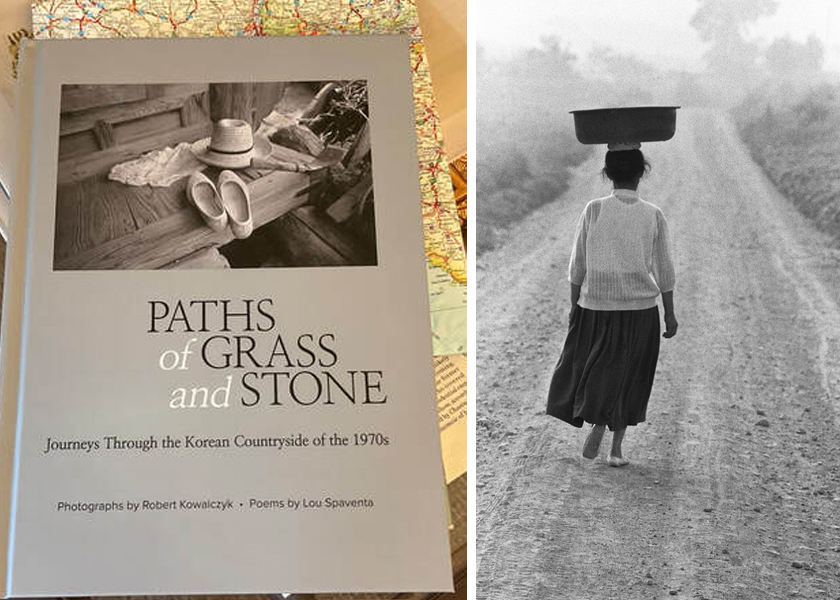
Black-and-white images of Korea in the 1970s are sensitively captured in this collaboration by a photographer and a poet who both served as Peace Corps volunteers then. It focuses on ordinary people at work, rest, and play, and the photos are accompanied by appropriate descriptions in poetic verse.
The elderly sit and chat, perhaps reflecting on their lives. The young look impatient, wanting more than what the countryside can give. The images show the smiles of children, the rough working hands of farmers and fishermen, the weathered faces of men and women. All of the photos are deceptively simple, like snapshots in time. Collectively, the frozen moments ascend to a new level of deeply-felt emotions.
After the brutal Korean War displaced some six million lives, the country was in ruins. The post-war years were characterized by poverty, disease, and psychological and physical trauma. The country struggled as an agrarian state, with 80/20 ratio of rural population to urban. Under the authoritarian President Chung Hee Park, a national modernization policy would reverse the ratio to an astounding 20/80 ratio.
In the ‘70s, there were few large cities. The country was populated by farmers, fishermen, and laborers living in remote villages.
In that era, there were few dictates by the national government that extended to the countryside. People made a living much as their predecessors had, following the rhythms of the four seasons, working from dawn to dusk.
One photo shows a lean, strong man wearing a jige or versatile wooden backpack frame, an image that sums up the kind of physical endurance needed to make a living in rural Korea at that time. American soldiers stationed in Korea starting in 1950 at the time of the Korean War, dubbed the structure an “A-frame” because of its simple yet sturdy shape. The soldiers were amazed at the quantity and weight of supplies that Korean laborers could carry with a jige.
Many of the images remind us how drastically times have changed. The jige was an ordinary sight in Korea for many centuries, but is rarely seen today.
Some images possess an additional evocative power. For example, there is one of an elderly woman in Gwangju tossing water from a bucket into the street. The photo shot at the optimum time, with water suspended in mid-air. The accompanying verse is haunting. Gwangju was the site of the 1980 pro-democracy movement, variously called the “uprising” or the “massacre,” depending on one’s politics. The elderly woman throwing out her wash water could very well have witnessed the 1980 Gwangju protests, when Koreans demonstrated for democracy. Many ordinary people were harshly dealt with by the authoritarian government and many lives were lost in the quest for democratic rule.
As if I could wash away
the day before and before that
As if I knew how to
cleanse village, home, heart… heavy with years
Blood ran in these streets
we scrub… water does not last
It should be noted that as the South Korea government was attempting to suppress the events of 1980 in Gwangju, American Peace Corps workers and other foreign organized religious and non-profit organizations were ordered to pack up and leave. South Korea ended the longstanding Peace Corps national volunteer program soon thereafter. News of what happened in Gwangju – the brief pro-democracy takeover followed by a harsh takedown by the government’s military – was controlled for years, so international reaction was muted.
Other black-and-white photos show the elderly in repose, with men drinking soju, and playing the traditional board game changgi. Boys in fields of tall grass try to catch grasshoppers. An old woman is shown drying wild ginseng (insam), a medicinal root that has been a vital part of Korean culture for thousands of years.
What ails you brother? Your wife
has whispered to me
“My husband, he..”
then blushing cannot finish the thought
Perhaps this simple root… in your tea
is all you need.
One detailed headshot shows an elderly man with long, wispy strands of beard, and a quiet gaze, looking askance. He looks like he has lived through a lot, and although he cannot or won’t speak of it, his deeply-lined face and pensive look tell a story. The somber poem that accompanies the photo resonates with remorse.
What I have seen may no one
See
What I have done may no one
Do
As I close my eyes this is what I
Pray
The careful curation of photos with poetry are nostalgic, quiet and stirring, with a sense of loss and longing. It is a beautifully-produced book, appropriate as a gift to a younger Korean who has no experience of that time of Korean history.
Kudos to the two authors who lived and worked at that time in the Korean countryside, and engaged with many rural local people. Additional contributors also helped make Paths of Grass and Stone a wonderful book.
Poet Lou Spaventa served in the Peace Corps in the Gwangju region. Originally from Brooklyn, New York, Spaventa has lived and worked in Korea, Saudi Arabia, England, Columbia, Mexico, and other places. He has been both a college professor and a foreign service officer, while always engaged in music and writing.
Photographer Robert Kowalczyck is now a retired professor at Kindai University of Osaka Japan. He once worked as a Peace Corps coordinator in East Asia. He has shot photos of people and landscapes in Korea, Japan, China, Russia, and Cambodia. More of his photos can be viewed at: https://robertkowalczyk.zenfolio.com/blog
After her tour of duty with the Peace Corps (1975-1977), Kathleen Stephens rose to become an American career diplomat, serving in China, Europe, and Washington, DC. She returned to South Korea as the first woman U.S. ambassador (2000-2011). She has served on the board of the Korea Society and the Asia Foundation.
Michael E. Robinson, a graduate of the University of Michigan, served in the Peace Corps in Korea (1968-1970). He continued his studies in East Asian History, and taught history at the University of California – Los Angeles and at Indiana University. He has published extensively on topics of Asian and Korean culture and history.
Translator Brother Anthony (known as Sonjae An in Korea) has been a member of the ecumenical Community of Taize since 1969. He located in South Korea in 1980 at the invitation of the Archbishop of Seoul, Sou-hwan Kim. An Oxford-educated scholar, Brother Anthony has taught at Sogang University, a private Jesuit-founded college, and published some 60 volumes of translated Korean poetry, and novels.
John Einarsen is the founding editor of Kyoto Journal (1987). He is a practitioner of Miksang contemplative photography, and has published numerous photoessays. The images of calm, solitude and contemplation in Paths of Grass and Stone clearly show Einarsen’s influence.


