Witness to Korea 1945 to 1947: The Unfolding of an Authoritarian Regime ~ Edited by Frank Hoffmann and Mark E. Caprio
An analysis of two accounts by expert eyewitnesses of U.S. rule in the post-war years
(Academia Publishers LLC, Berkeley (CA), 2026, ISBN #978-1-9560-6791-0)
Review by Bill Drucker (Fall 2026)
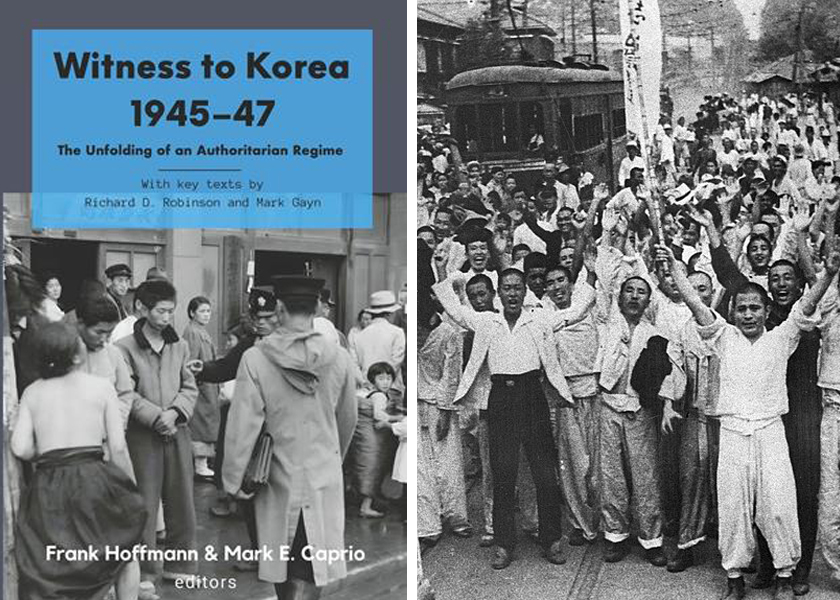
In this collection of essays, writers analyze and review author Richard D. Robinson’s Betrayal of a Nation and journalist Mark Gayn’s Korea section of his Japan Diary. Both Robinson’s and Gayn’s books contain the authors’ own experiences and eyewitness accounts of how the post-Liberation U.S. occupation of South Korea was rolled out in the early years.
As the title suggests, these histories concentrate on the period between 1945 and 1947. They were turbulent years as South Korea and the U.S. struggled for control in the newly-divided nation. Robinson and Gayn offer political analysis with personal eyewitness observations, and do so with brutal honesty. Both concentrate on the early Cold War politics of the U.S. Army Military Government in Korea (USAMGK) and the U.S. authorities’ support of right-wing Korean politicians.
Because of the anti-communist sentiment of the times, both authors were hindered by attempts at official censorship and suppression of their writings. Later, both were publicly attacked as a part of a crackdown by Sen. Joseph McCarthy, and his anti-communist campaign in the U.S. Congres
The compilation of modern analyses in Witness to Korea is important because the essayists’ perspectives of the Robinson and Gayn histories are not revisionist history or a re-interpretation of the original histories. There was an environment of suppression of anything counter to official U.S. policy toward Korea at the time these two accounts were published. It is as if these two important histories were never seen by critics at the time of publication. To readers today, the collection in Witness to Korea is like reading review of a history book that has just been published.
That the Robinson and Gayn writings were quietly buried and ignored at the time of their publication, makes this revisitation revelatory. Both authors recount on-the-ground eyewitness testimonies of important events. Both were knowledgeable, seasoned, and reliable professionals: Robinson from within the U.S. Army while on the ground in Korea; and Gayn, an international news journalist who had already spent many years reporting from Asia.
Both Robinson and Gayn offer critical contributions on the turbulent years, mostly 1945 to 1947, including the official account of events, information on what was suppressed, and how the two writers were reprimanded and censored for telling their stories.
Just prior to writing his eyewitness accounts that would become Betrayal of a Nation, Robinson was a new U.S officer assigned to the administration of U.S. occupation forces in the newly-surrendered Japan. In 1945, he was sent to Korea as an officer in the USAMGK, in the office of public opinion. He and a handful of historians were assigned to write an official history of the U.S. occupation in South Korea.
The conscience of a whistleblower
Robinson witnessed and wrote about the U.S. military supporting conservative and right-wing Korean politics. He saw the suppression of democracy in the struggling little nation, and was cognizant of how his official history was censored. Morally, Robinson felt he was caught between a rock and a hard place. As an officer, he was answerable to the U.S. Army. He knew he could face arrest and court martial if he disobeyed. He was also a man of conscience. He was eventually told by his superiors not to disclose his writings. He felt threatened and his family was under military surveillance.
Rather than continue in this predicament, he left the military in 1946. He worked as a civilian historian, but still felt pressure not to disclose his official history of the South Korean occupation by the U.S. He fled with his wife to Turkey in 1947. In 1956, he returned to the U.S. as a lecturer and worked at both Harvard University and the Massachusetts Institute of Technology (MIT) from 1962 to 1986. He did not abandon his writings about Korea, and in 1960, he completed Betrayal of a Nation but the publication was not widely circulated.
Robinson characterized his observations of U.S. policy and management in Korea between 1945 -1947 as critical, but not unfair. He described the U.S. ham-fisted intervention, the later failures of South Korea’s first president, Syngman Rhee, and the endless U.S. bickering with Russia that would only lead to a Cold War, and eventually to the Korean War.
Observations of a foreign correspondent
Gayn (1909-1981) was born in Manchuria, lived in Harbin, China, and eventually moved to Shanghai for reasons having to do with hunger, revolutions, and wars. He joined the Washington Post as a journalist. His liberal views and Asian sympathies got him and fellow journalists arrested.
In 1945, Gayn was the Chicago Sun’s bureau chief for Japan and Korea. His Japan Diary, published in 1948, is critical of U.S. occupation politics. It was a successful publication, but it was attacked because of its viewpoint on the U.S. policies toward South Korea in the post-1945 era, particularly the U.S. government’s behavior during the occupation years. His publication was also targeted by Sen. Joseph McCarthy’s Permanent Subcommittee on Investigations, which held high-profile, televised hearings, ostensibly to investigate communism in the U.S. government, during 1953 and 1954.
A naturalized U.S. citizen, Gayn relocated to Canada in 1952, and after that, worked for the Toronto Daily Star and other publications. During his career, he also wrote for Newsweek, Time and The New York Times, and was a member of the editorial board and the senior foreign affairs correspondent for The Toronto Star at the time of his death in 1980.
In Japan Diary: Korea, Gayn writes of how he personally witnessed and recorded firsthand accounts by others of U.S. actions in occupying Korea, the role of Korean right-wing groups, and the consequences to the Korean people. Gayn argues that the U.S. never understood that South Korean leftists were nationalists seeking self-determination after longtime subjugation by Japan, and that they were not communists, subversives, or terrorists.
This fundamental misunderstanding of Koreans’ issues as a people and as a nation created a tense kind of governance by the U.S. in these early years, which comes out in Gayn’s writings. Illegal raids and arrests of civilians were frequent by the police, U.S. military, national youth paramilitary groups, and (first President) Syngman Rhee’s terrorists.
Gayn was witness to U.S. terrorism against Korean youth. In one of Gayn’s accounts, a young man was questioned by the local police in Gayn’s presence. A translator was brought in, perhaps because Gayn was there. Gayn perceived the denials, the stonewalling, the gaslighting by the police, and by the possibly-biased translator.
After the interview, Gayn and his wife Charlotte were called in by Major Gen. Archer L. Lerch, then the American Military Governor of Korea. Lerch was polite, subtly chastising them for not seeing him before arranging to see the youth, which Gayn took to mean “mind your business in Korea.”
Getting the country up and running amid the devastation of post-war South Korea was a U.S. taxpayer’s black hole. Even the inept and overwhelmed Gen. John Hodges Commander of U.S. Armed Forces in Korea (USAFIK) from 1945 to 1948, knew the problems of the little, unstable state and its issues in terms of basic economics and politics, and tried ineffectively to work on its ruined systems.
Hodges was known later for bringing in Japanese administrators of government departments, in effect, putting the Japanese back in the drivers’ seats of a country they had recently been forced to leave. Koreans were outraged, and protested loudly. Hodges had to backpedal. As Gayn was quick to point out, the failures of U.S. are not so much in the “complexities of establishing stability in Korea, but in the failure to act constructively.”
On a plane leaving Korea, Gayn hears another passenger say, “Goodbye, Korea. I am happy to be leaving!” Gayn admitted he too was happy to leave, after an onerous assignment. But he was also ashamed of America’s inept bungling. His book was read by North Koreans, and a Russian version was also translated and published. Gayn, who died in 1981, lived just long enough to see South Korea become a fledgling democratic state.
Eyewitness stories come into the light
The long-neglected Robinson and Gayn’s writings on Korea (1945-1947) came to light in unexpected ways. Three expert academic contributors narrate and analyze the history from the perspectives of the two eyewitnesses in the Witness to Korea collection.
In At Long Last, contributor John Merrill reveals how he became interested in Betrayal of a Nation. As a graduate student, he was assigned by a professor to find Betrayal of a Nation and read it. Merrill and Robinson were coincidentally living in the same Boston neighborhood at the time, Merrill at Harvard, and Robinson across the Charles River at MIT.
At that time, Robinson had returned from Turkey (in 1956) and was teaching Mid-Eastern Studies at MIT. Merrill wrote to Robinson to ask if he would donate a copy of Betrayal of a Nation to the library at Harvard, and Robinson did so. Robinson’s work has since become an important source of information for scholars and students of Korean studies.
In his academic career, Merrill was a visiting scholar of Korean Studies at George Washington University. He has taught at Georgetown and George Washington Universities, and published Korea: The Peninsular Origins of War and Inside the White House: The Future of U.S.-DPRK Policy. In his non-academic career, he is retired from the State Department as the chief of the Bureau of Intelligence and Research Northeast Asia Division.
Notes on U.S. mismanagement and policy blunders
Essayist Mark E. Caprio, in his contribution, entitled Democracy, Authoritarianism, and Culpability in Southern Korea: Gayn and Robinson on the U.S. Military Government, examines the events as described by Gayn and Robinson. Caprio notes that there are parallels between the mismanaged situation as described by the two authors in their respective books and the glaring shortcomings of the U.S. military management in Iraq and Afghanistan.
This mismanagement, and the unfulfilled promise to deliver independence to Koreans in 1945 as promised, is a persistent source of resentment between the two countries.
Mark E. Caprio has written extensively on colonial Korean policies, Japanese assimilation policies, Korea’s attempts at post-war sovereignty, and similar topics of Japanese-Korean relations.
In Richard D. Robinson and Mark Gayn: A Whistleblower and a Journalist, essayist Frank Hoffmann relates that he met Robinson at Harvard in 1998 (page six of the book). Hoffmann didn’t get a chance to access Betrayal of a Nation from the Harvard Yenching Library, but a few years later, colleague Mark Caprio loaned Hoffmann his own copy. Hoffmann took an interest in what Robinson chronicled, particularly the interventionist policies of U.S., the rise of Korean right-wing politics, anti-communism, the advent of the Cold War, and the forecast of another war.
In another essay by Hoffmann entitled Chechen Sie Deutsch? Fascism in Korea, he examines the effects of military-backed authoritarian rule and the suppression of the democratic state. He reviews the various authoritarian regimes in South Korea’s history, including President Syngman Rhee’s administration and the dictatorship two decades later of President Chung-hee Park.
Hoffmann further compares the rise of Hitler’s fascism with post-war South Korea’s U.S. military interventionist policies and practices, supported by Korean right-wing groups, and vigilante Korean National Youth Groups, which were funded by right-wing groups to to bully, beat up, and kill citizens suspected of agitating for democratic rule and against authoritarianism. These youth groups justified their overreaching tactics as acts of patriotism.
Hoffmann’s background was in Korean studies and art history at the University of Tubingen in Germany, modern Korean studies at Harvard, and teaching history at other academic institutions. He is currently at the University of California at Berkeley, and founder of Academia Publishers.
The topic of how voices of resistance struggle to be heard amid the rise of authoritarianism is a worthy one to study in today’s political climate. This is a profound and thoughtful book, profuse with rare war photographs and once-classified data. It celebrates two of the very few brave voices of the post-war era who would not stop speaking their truths about an important moment in history that was once long buried and nearly forgotten.