
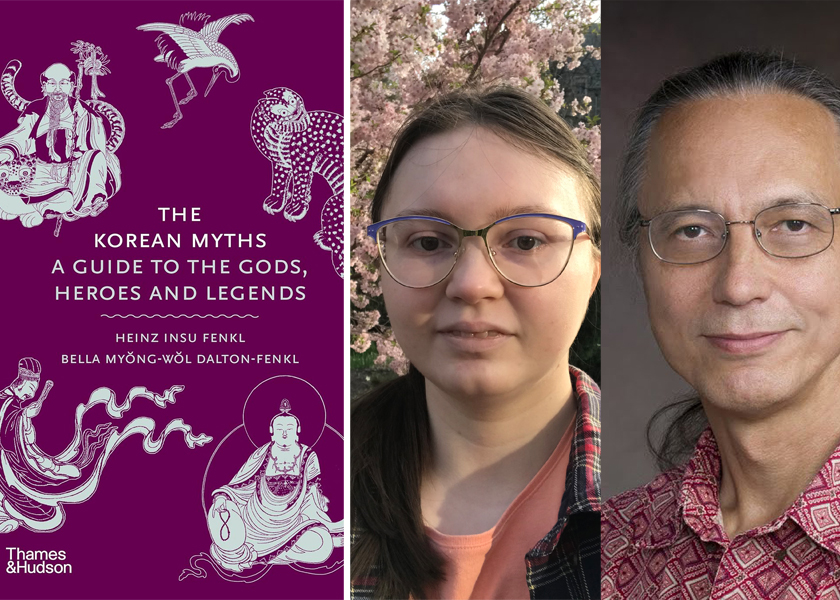
The Korean Myths: A Guide to the Gods, Heroes and Legends ~ By Heinz Insu Fenkl and Bella Myong-Wol Dalton-Fenkl
New review of ancient Korean stories show their tenacity through history and into the present
(Thames and Hudson Press, New York, 2026, ISBN #978-0-5000-2766-0)
Review by Bill Drucker (Summer 2026)
Myths and legends, with their heroes, gods, goddesses and supernatural creatures, are not only memorable stories, they can also be the foundation for a nation’s culture.
The Korean Myths: A Guide to the Gods, Heroes and Legends, by father-daughter team Heinz Insu Fenkl and Bella Myong-Wol Dalton-Fenkl, explores how Korea’s ancient stories and characters are not only fascinating on their own; they are the source of key beliefs among Koreans today about their origins as a people.
The interrelationships of divine and human consistently prevail in Korean myths, and its many stories explain concepts as simple as fire and as complex as poetry, art, spirituality, identity and destiny. The authors demonstrate how the ancient stories of Korean culture are not simply relegated to the history books; on the contrary, they are seamlessly incorporated into the cultural fabric of modern South Korean life.
What’s a myth, a legend, a folktale?
The authors unravel the complexities of myth, legend, and folklore in this joyful read, which is complemented by numerous illustrations. They define myths as stories of divine and other supernatural beings, along with fictional human heroes of extraordinary virtue. Many myths are so old that their origins are as oral stories, passed down through the generations long before they were ever written down.
Legends are a subset of myths; they are stories based on real events and people. Some examples of Korean legends include: stories of the ancient King Jumong and his son Yuri; King Sejong, credited for inventing the Korean writing system; Queen Seonduk, an astronomer and Korea’s only female national ruler; and the military leader Admiral Yi who defeated the Japanese incursion with his armored turtle ships. These and other unique and heroic people are referenced as a source national pride and identity among Korean people today.
Folklore refers to shared values, collective traditions and identity of a cultural group. It appears in visual arts and crafts, such as statues, demon posts and masks, in performing arts like sung stories, folk songs, and percussion, and in clothing such as ceremonial dress.
Folk culture has been communicated through the generations by monks, shamans and itinerant musicians and performers. For example, the folk song Arirang is so beloved and embedded in the culture that many regions have their own version of the song, while both Korean states embrace the song today as part of their national heritage.
How earth came to be
The authors explain Korea’s myths and legends with illuminating detail. The first chapter describes creation myths. Most cultures, including Korea, have myths of how order was created from chaos, how light came into the world, and how heaven and earth came to be. Korea’s creation story was told orally, then at some point ritualized in song, and eventually written as the Changsega (or Song of Creation).
The earliest Korean gods of creation were Mireuk and Seokga, derived from Buddhist beliefs. Other stories revolve around two female goddesses, Grandma Mago and Grandma Seolmundae. In northern regions, the story goes that Mago dropped mud from her skirt. Where the mud fell, mountains and islands formed, Her bodily functions became rivers and hills. Popular in Jeju, Grandma Seolmundae or Seolmago birthed 500 sons, who searched for food and hunted for game to feed their enormous mother. The crater at Mount Halla served as Mago’s cauldron for her soup. Sadly she fell in. When the sons returned to eat the soup, they found her bones at the bottom of the crater.
The Jeju squat hareubang statues (the serious-faced stone “grandpas” seen in many locations on the island), also have various divine stories attached to them.
The divine touches all
Surnames, also known as clan names, are imbued with divine connections, told in story form. For example, the name Kim (meaning gold) was the clan founded by a rooster crowing at a divine golden box, from which a boy emerges and takes the name Kim.
The Jeju haenyeo (sea women) or free drivers, who make their living by diving for seafood in deep water, training themselves to hold their breath for long periods, are rooted in myth. The story goes that a grieving wife who lost her husband at sea so moved the Sea Goddess, that she gave the woman power to breathe underwater in search of her husband. The haenyeo are a close-knit women’s community that has existed for perhaps 1,500 years, with mothers teaching the craft to daughters and granddaughters. Some haenyeo are also practicing shamans. There are few haenyeo left since modern technology has taken the place of the more dangerous free-diving fishing method.
The authors also explore the myths and legends associated with religion. There is a marvelous syncretism in combining native spiritual beliefs with myths. Shamans extol the local spirits as well as appealing to Buddha in song. Buddhist temples integrate the local deities of the mountains and rivers. Buddhism, Shamanism, local animism, ancestor worship, Christianity and Taoism overlap.
Korean shamans – revered and reviled
Unique to Korea are shamans, gifted individuals with access to the spirit world. Historically, the shaman culture has been persecuted by the state, and ostracized by the community, but shamans have persisted with their rituals through the ages, and those rituals are now recognized and celebrated. People from across the economic and political spectrum may seek out a shaman. The shaman may be called by a grieving parent, or by the mayor or even the president to offer blessings. Often, shamans are sought to deal with bad spirits, but they are also invited to joyful occasions and holidays, or even to give a blessing to a whole community.
Spiritual rituals permeate the Korean culture. From Buddhism, the Bodhisattva Gwan Yin has become the patron goddess of mercy and a saint of womanhood. In early Buddhist myths, Gwan Yin appeared as a male. As a female deity, Gwanseum resembles the Catholic Mary, mother of Jesus. Both share the virtues of compassion, and are often depicted standing with open hands and a gentle demeanor. This shows how Korean culture recognizes a syncretic harmony among religions, even those that seem very different, like Buddhism and Catholicism.
Roots of superstition
The authors also look into ghosts, spirits and superstition, the non-religious aspect of Korean spirituality. Korea has a long, complex history with the supernatural, and superstitious practices persist today. For example, many Koreans avoid giving shoes as a gift, because superstition suggests that the recipient could put them on and then walk away forever. Money is given as a gift on the lunar new year, and often a clan will buy a pig’s head for the family party and put rolled-up money in the mouth, nose and ears; this is because money is lucky and a smiling pig is also a lucky sign.
Some of the famous supernatural beings have names and their own virtues. The Sanshin (literally “mountain spirit”) is affectionately called the Old Man (or Woman) of the Mountain and is probably Korea’s most depicted spirit in the indigenous religion. A gwishin or ghost spirit is created when a human dies with unresolved issues. The gumiho or nine-tailed fox can shape-shift to look like a human and can feed on souls. The dokkaebi is a malicious (but not evil) goblin that tries to trick humans.
Spirit animals and healing plants
Animal myths are also plentiful in Korean myths and folklore. The dragon is considered a magical and benevolent guardian. The tiger is a powerful spirit, often seen in the presence of mountain deities. The wolf is seen as a link between the earthly realm and the divine, and noted for its intelligence. The cunning fox and fox goddess are symbols of trickery. The rabbit is beloved and descended as a pet of the moon goddess. Instead of seeing “the Man in the Moon” face that Westerners are taught to look for, Koreans see a rabbit shape on the full moon.
Plants, such as the Korean hibiscus (mugunghwa or Rose of Sharon) and ginger have their own mythological meaning as gifts from the gods. In tradition these and other plants are revered. Today, they are known for their medicinal powers, are sold commercially for their healing powers. The Korean mugunghwa is South Korea’s national flower, symbolizing eternity. The ginseng root is known for looking like a headless human body, with its beige color, and usually two roots for arms and two for legs. It is known to have some strong medicinal effects in recovering from fatigue and boosting immunity. Ginger is used widely in Korea in health drinks, herbal medicines, and as a flavoring.
The traditions of storytelling are also explored as part of the book. Oral storytelling of legends and myths is a part of Korean culture. As stories were written down, literary devices were added. In western folklore, a story begins with “Once upon a time.” In old Korean folklore, the story begins with “When tigers smoked pipes” or just “When tigers smoked.” In Korean folklore, nature is depicted as intelligent, alive and communicating with the divine. Animals and trees talk to humans. Gods and goddesses lived in the oceans, mountains, rivers and streams, as well as in the heavens. Stories are intended to amuse and demonstrate morals, courage, cleverness and generosity. Stories also extol moral virtues of intelligence, honor and sacrifice.
For example, the Korean classic love story, Tale of Chunhyang tells of a virtuous and steadfast woman who is true to the one she has promised her love. Chunhyang is so beloved for her unwavering heart that her story has been told and retold in books, songs, pansori, and even in K-dramas.
Myths that sustain the modern state
The authors also review how myths work in Korean society today, specifically the modern myths that have created and sustained North Korea. The nation of North Korea was established in 1948, with its own ideology and legendary characters in the form of the three Kim rulers. In their legendary personas, the Kims are perfect, almost divine, uncontested. Founder Il Sung Kim, knowing the power of ideas in the Korean tradition, developed an ideology, juche, the Korean word for self-reliance.
In its own mythology, North Koreans have used their independence and self-reliance to become a successful country in a competitive world. In point of fact, the nation is poor and isolated, and needs to be more interdependent with other nations in order to thrive. Recently, its economy has faltered without the economic and political support of China and Russia. Today, leader Jong Un Kim, grandson of the founder, is the figurehead of the government, and also the symbol of the central mythology of the nation.
In an inspired moment, the civilian South Korean President Dae Jung Kim crossed the Demilitarized Zone ( DMZ) between South and North on June 13, 2000 and entered North Korea for the Inter-Korean Summit, and the two Kims embraced. This was the stuff of legends after many years of hostility and silence. Koreans everywhere held their breath with high expectations that the two leaders could negotiate a path to reunification. Sadly, hope was an elusive butterfly. Detente remained, and dreams of unification faded.
Despite past pressures on North Korea to negotiate its nuclear status, and despite the imposition of sanctions by the U.S., and even threats of war under Presidents Bill Clinton and George W. Bush, North Korea has pushed forward into the future. That, in itself, makes the little country legendary.
Myth meets hallyu
In the final chapter, the authors examine how Korea’s ancient stories and belief systems effect the modern country Korea has become. They show how, under a facade of modern technology and world class economics, South Korea is indeed steeped in its traditional roots of Buddhism and Confucianism, along with its indigenous shamanic belief systems of many characters – gods, goddesses, ghosts, demons, magical creatures and all the stories that give them life. The country itself is a constant reminder of the past, with its ancient structures, including many temples that are still functioning with its ancient texts with stories of everything from mythic creatures to actual kings and queens. Therefore, South Korean identity is complex, with many demands of the modern world and deep connections to the culture’s storied past.
In showing this connection, the authors reference South Korea’s most popular source of cultural information – K-dramas. Many ancient stories have come alive on our televisions because of the number of K-dramas that have adapted them. The Korean wave of popular culture (hallyu) sent K-dramas and K-pop across the globe, providing global visibility and an informal ambassador for Korean culture.
Since K-dramas were invented, writers have drawn on Korean myths as story lines, including: A series on the warrior king Jumong; a series on Queen Seonduk of the Shilla kingdom; one focused on the achievements of King Sejong; and a story about the mythical character Hong Kildong, known as Korea’s Robin Hood, among many others. Viewers have absorbed information about various (possibly fictional) versions of Korean history, geography, place names, traditional clothing, music, dance, and other cultural information through these stories.
This book is a small-size volume, and I wished when I was finished that it could be produced as a large coffee-table type format, to better show the beautiful photos and illustrations. The authors have dug deep in research to produce this interesting and unique study; it is a lot of fun and provides some very informative reading in a small package.
Korean American Heinz Insu Fenkl was born in Bupyeong, Korea, 1960. His interest in fiction began as a boy when he discovered serial graphic novels and comic books. He has become a familiar author, translator, and editor in America and in South Korea. He has also translated and produced several North Korean comic books as a series for Korean Quarterly. Currently, he teaches creative writing and Asian studies courses at the State University of New York, New Paltz.
Creative collaborator Bella Myong-wol Dalton Fenkl is an accomplished artist and photographer. She is a translator of Korean literature and created the bi-lingual Korean/English comic series Space Bunny, for Korean Quarterly.


