Editor’s Note: The case of Korean adoptees, former ICE detainees, the East Wing, and how legal systems cannot deliver justice | By Martha Vickery (Spring 2026)
I don’t know if it’s the numbing lies and inconsistencies of the Trump administration, still feeling the raw trauma after Operation Metro Surge, or learning more over time about the Truth and Reconciliation (TRC) investigation of Korean adoptee records in South Korea. But I feel more than ever, the annoyance of small acts of injustice that are temporary, and also the crushing load of global injustices that seem to have no remedies.
There was one tiny bright spot recently.
One woman, Alison Hoagland, is named as the plaintiff in a lawsuit against Donald Trump, along with a whole lot of federal departments including the National Park Service. She is on the board of the National Trust for Historic Preservation, a non-profit organization that guides decisions on changes to national landmark buildings.
The building in question is, of course, the White House. A judge issued a preliminary injunction on March 31 ordering construction to stop on the new White House ballroom, a Trump pet project. Carol Quillen, the president of the National Trust, issued a statement in response to the injunction, stating “This is a win for the American people on a project that forever impacts one of the most beloved and iconic places in our nation.”
At first, I thought, “Well, that’s good at least.” My second thought was “Is it, though?”
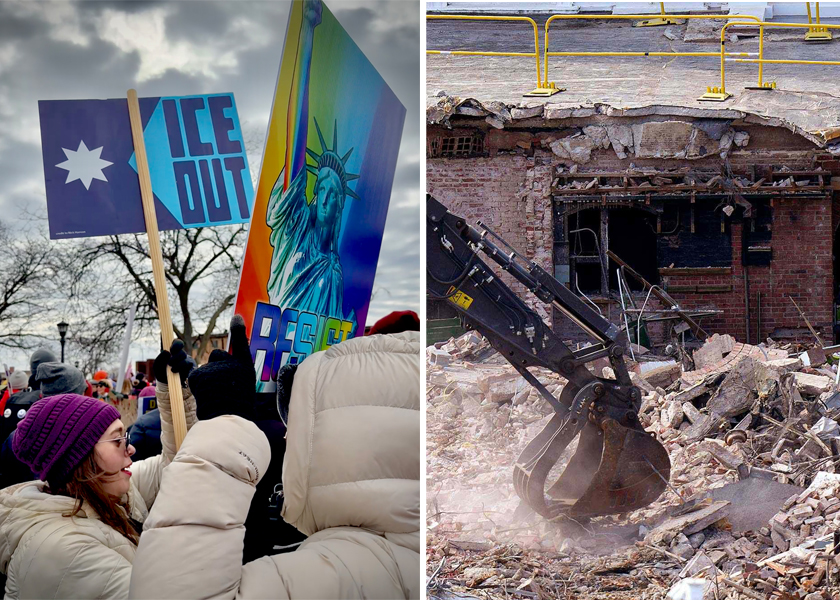
The National Trust guides the conservation of buildings that are historic and irreplaceable. The White House East Wing was demolished way back in October, 2025. Apparently, nobody could stop it. Trump ignored all the laws and policies concerning historic structures, and took a wrecking ball to it. What can the National Trust do at this point? What is the win?
The original colonnades (covered walkways) to the east and west wings were designed in 1805 by the architect who designed the Capitol and other famous Washington, D.C. buildings. There is (or was) a classical symmetry to both identical wings. The East Wing building was designed in 1902, and redesigned in the ‘40s under Franklin Roosevelt to include an underground bunker. The East Wing demolition also destroyed the Jacqueline Kennedy Garden.
After the demolition began, many news organizations put together nostalgic photo collections of historical events that happened in the East Wing. There are many moments.
The footprint of the new building will be three times that of the White House. The finished ballroom could make the White House look like a fancy middle school that needed a new wing for the gym.
The preliminary injunction is not useless. It gives the granting authorities some time to figure out whether the new ballroom building can be modified in size or style or both, to match with the rest of the historical building. Or, perhaps, whether it should not be built at all.
However, is hardly “a win” for the American people. It is undoubtedly a tragic loss, from a historical perspective.
So much has been happening, from October 2025 to the present, that the fiasco of the illegal East Wing demolition has been barely a blip on the radar of the pointless waste of money, time and human capital visited on our country by the Trump administration.
Personally, I only had a few passing thoughts about the stupidity of it, until reading the slightly good news about the temporary injunction today.
It stands out though – if only as symbolic of how the Trump administration operates. It’s a representation of the general overall disaster that we can barely imagine. It is physical proof of the vacuum – or hole in the ground – where the role of Congress used to be.
The injunction shows us that the judiciary is at least still operating. But it has a small part in preventing lawless action; the court system’s job mainly kicks into gear after the fact.
The East Wing demolition is particularly insulting because of its permanence. No court case can undo it. The ugly scar on the landscape is an example of how attempts at reparations, even sincere ones, usually fail.
Another recent event was a lawsuit by six Twin Citians, all people of color, who charged that household members were arrested and detained after illegal warrantless home searches by ICE. It’s a pleading of “can’t someone at least enforce the existing laws?” ICE broke down the front door of one couple’s house with a battering ram and took away the man in front of his school-age daughter and niece. Two of the men who were detained after the warrantless search were sent to detention centers. One of them, detained for 17 days, was denied access to his medication.
None of the plaintiffs were wanted for a crime. An administrative warrant was used as a pretense for entering the homes by force.
Tiny law lesson – In case you missed it, or like me, have trouble remember the normal days any more – in the scenario of normal police procedures under normal laws, an administrative warrant is legally insufficient for police to enter a home to search for a person without the resident’s permission. Only a judge can sign off on a judicial warrant, and the law enforcement branch requesting the search has to show a cause for the home search.
Like the East Wing example – except more serious – this suit may accomplish something, but not a lot. It would uphold current law and potentially stop DHS from violating people’s Fourth Amendment (protection from illegal search and seizure) rights in the future. But it will not restore justice to those who were held at gunpoint, kidnapped by masked thugs, thrown into vans, subjected to the uncertainty and trauma of detention, missed work, were denied their medicine, etc.
But will it elicit a public heartfelt apology and anything like reparations from the federal government for the disruption, terror, stress and pain? Again, probably not. Governments generally do not apologize. Even when they do, they do it so poorly.
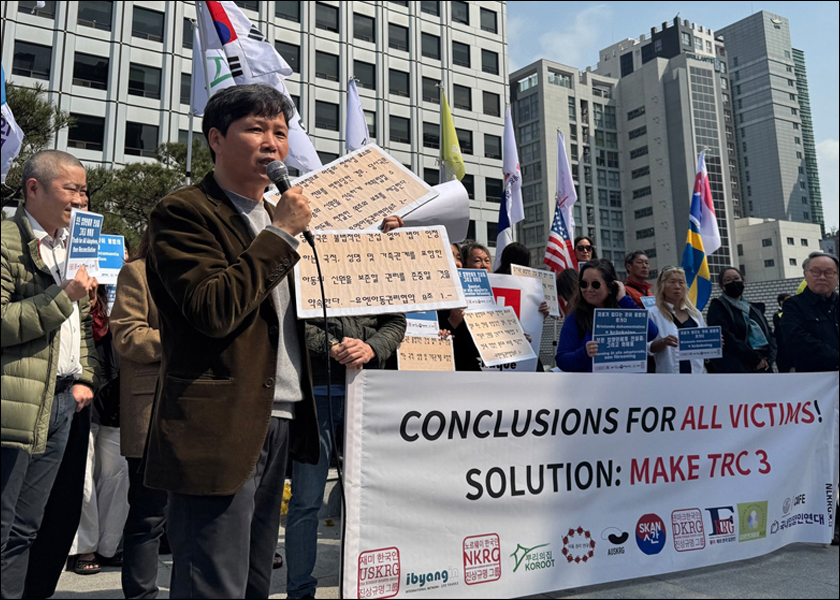
Case in point, back in South Korea, an official government investigation commission, the Truth and Reconciliation Commission (TRC), started its third consecutive investigation of fraud and mismanagement of Korean adoptees’ adoption records; this phase could be going on for two or three years.
In a public demonstration in Seoul on February 26, including a colorful display of signs and flags from many nations, Korean adoptees brought 311 voluntarily-submitted files to the TRC on the first day of its third investigation.
This official inquiry into human rights violations by the government began with a group of Korean adoptees from Denmark, the Danish Korean Rights Group (DKRG), whose human rights complaint against the South Korean government was then referred to the TRC in 2022. Adoptees from other countries also submitted their files to the TRC for investigation. The TRC’s (second) investigation ended with a published report in March 2025, concluding that there is enough proof of fraud to be considered a human rights crime under South Korean law.
A large group of adoptees have been harmed by struggling with fraudulent adoption records that make it difficult or impossible to find birth family. There is evidence that some adoptees were placed for adoption without permission of their families. There are allegations of human trafficking, particularly during the era of speeded-up adoption processing in the 1970s and ‘80s.
It is unlikely that this reality can be remedied in a way that can repair the essential problem, but Korean adoptee leaders have some ideas for policies that would approach reparations. In a letter to the new president, the U.S. Korean Rights Group (USKRG), one of the newer, country-specific groups formed to represent Americans in this ongoing dialogue, made various suggestions on specific reparations that would help Korean adoptees. So far, the letter has not been formally answered.
Many of the suggestions relate to records access, for example, giving Korean adoptees free access to their records through South Korea’s National Archives portal database. Another request was to expand access to adoptee records to other birth family members of the adoptee (siblings, cousins, and birth descendants of adoptees) instead of limiting searching to the birth parents and birth child. A related suggestion was to promote the DNA database with a national campaign so that Korean parents who once placed a child for adoption would be encouraged to register, and could find their adult child through a DNA match.
Other suggestions have to do with staffing of a government office to help Korean adoptees with their birth searches. One of the logistical problems right now is the lack of staffing to handle the inquiries of adoptees asking to access their own records (last count was that six staff have been assigned to bring order to the records, and assist adoptee applicants. There are 170,000 or more records). The USKRG asked specifically about “services such as translation, transportation guidance within Korea, procedural assistance, and explanation of information contained in adoption records.” They also asked about language help, that all staff should be English speakers and that there also be some workers who are fluent in French and German.
Columnist Anders Riel Mueller, in his opinion piece Adoption as banishment, was one of 56 adoptees whose cases were reviewed and found to be human rights violations in the 2025 TRC report. The issues of the last TRC investigation, Mueller said, makes him cautious about the capacity of the TRC to deliver meaningful reconciliation to Korean adoptees.
During that almost three-year period of investigation, rife with prevarications and delays by the TRC, which was under the now-indicted and convicted former president Yoon-Seok Yeol, Mueller got an up-close and personal look at the inadequacy of any law-based organization to deliver something like a reparation.
Korean adoptees have tried various legal paths – lawsuits, and financial compensation claims – in their quest to create something fair, Mueller writes. “We are still waiting for the decisions on these claims. This uncertainty around the consequences of the TRC decision shows the limitations of its recommendations,” he pointed out.
Laws and policies versus justice and reconciliation – they are just two different concepts although they are often passed off as the same.
We can all feel what Mueller writes so incisively and says out loud, that “legal action or financial compensation do not equal justice.” We all know this, but we cannot resist hoping for the opposite. It’s kind of like hoping for the East Wing to reappear.
We cannot “restore the years lost to disorientation, cultural isolation and the expenditure of labor spent on reconstructing a history that the state itself worked to erase. They are tiny bandages on thousands of gaping wounds,” Mueller wrote.
All our legalistic and policy-tweaking methods can only do some things – just as a court order to stop the new Capitol ballroom can only bring attention to it, and possibly prevent future damage to the White House or other national historic buildings – but it can’t bring back the East Wing.
There will just have to be a gaping wound in the ground for awhile, and everyone at the White House will have to look at it. But that’s OK.
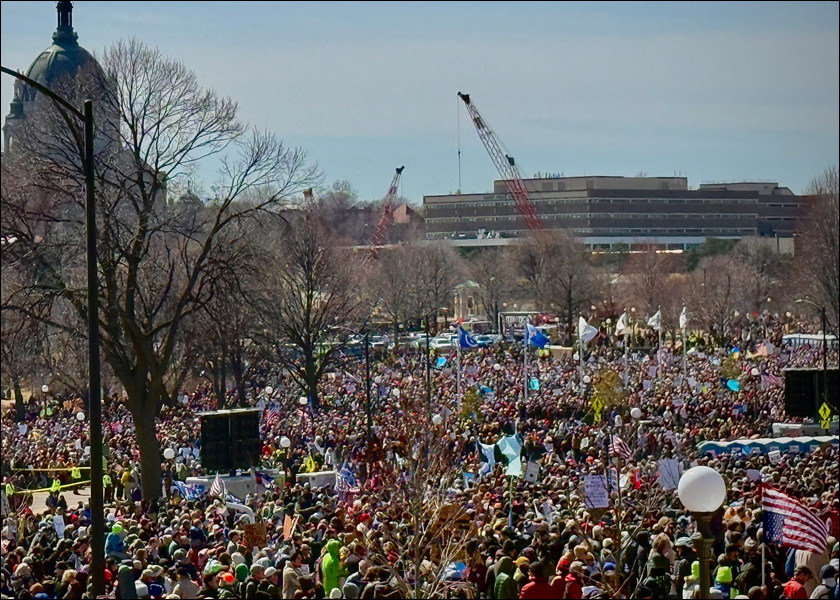
Even though real justice often seems to be a thing of our imaginations, or something sort of real, but just out of reach, we can find a lot of like-minded people thinking the same thoughts, like the eight million or more folks who went one of more than 3,000 locations for the third No Kings demonstration last week, as writer Brook Mallak pointed out in her personal essay The quiet strength of community.
I felt it too. Immersed in that community, practically squished flat against the Transportation Building at the Capitol Mall on March 28, there was a roar beginning to build from the bottom up that assured me that seeking justice is very popular right now. There is safety in numbers. We can follow, we can lead, we can rest in the middle, sitting in a lawn chair with our little sign. We can feel like we might be able to go on for awhile. Even if we have been intimidated, we can find the courage to speak out. Even if we have been discouraged, we can begin to take heart.