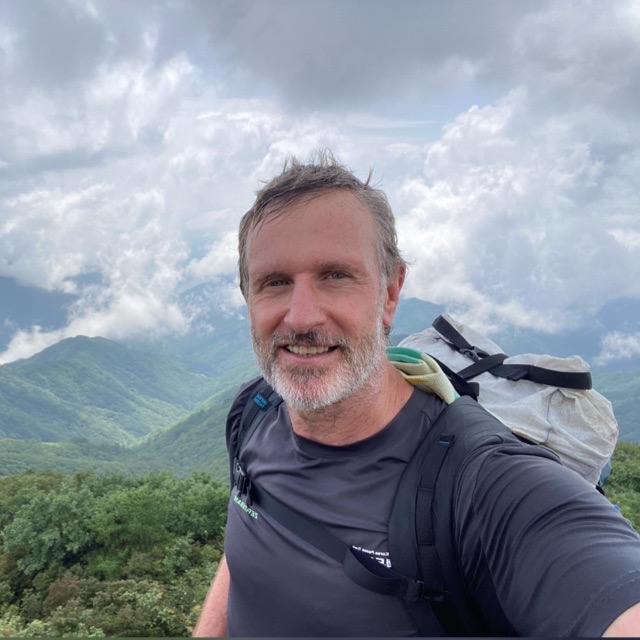
Traveling southwestern Korea with a local who greases the wheels of bureaucracy and formality by just being himself | By Roger Shepherd (Spring 2026)
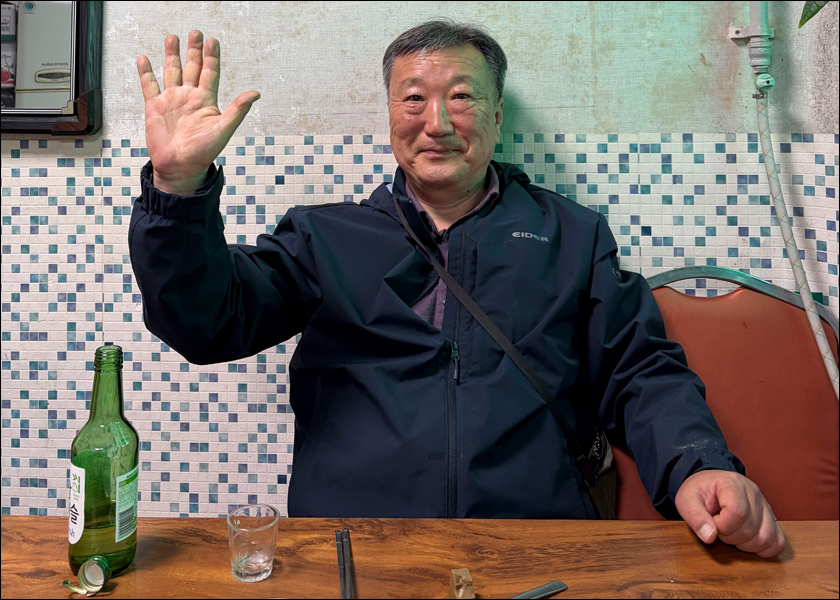
I met Gyeong-seon Kim about a decade ago. It was dark. I was sleeping like a tramp just outside the entrance to his village of Daegang-myeon, deep in Jeollabuk-do, with a big plastic bottle of makgeolli by my side. He found me there. He was older than me, with surprisingly good English.
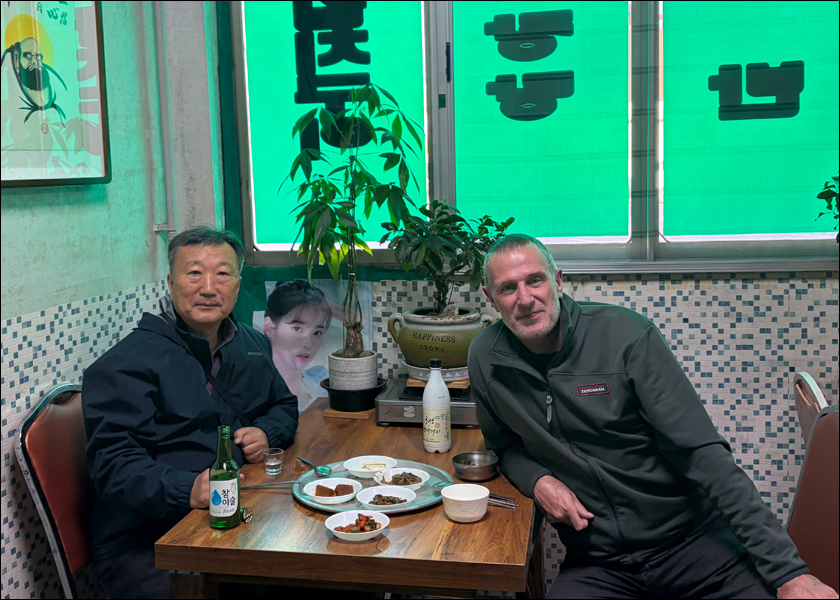
The next morning, we met again and went for a long, brutal hike along the ridge behind his house. For a portly man, he moved well. Afterward, we got properly slammed in a local sikdang (restaurant).
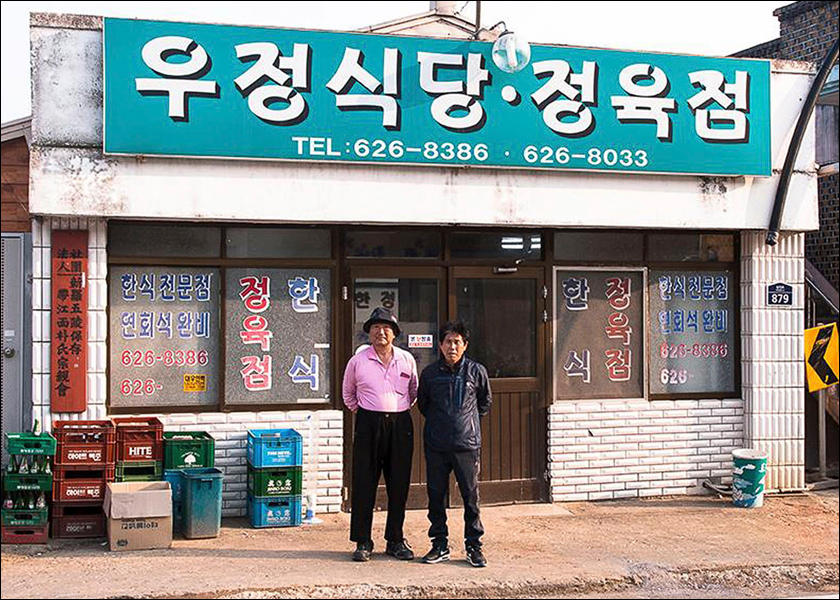
We kept in touch over the years. He’s got a good sense of humor, but he’s also what Koreans call a geon-dae, (spelled 꼰대 , a word for someone who clings to old ideas). In his case, that’s reinforced by a fairly right-wing political outlook, which makes him something of an oddity in a region dominated by left-leaning politics. Back when he was a civil servant, he aligned himself with the Minjudang Democratic Party. The irony isn’t lost on him, or on me.
Like a lot of married men I’ve met, there’s a quiet heaviness to him. Perhaps it is retirement, routine, a sense of things narrowing. Men need purpose more than stability. We will grind ourselves down chasing it if we have to.
He uses the word “nonsense” a lot. It is one of his favorites, deployed to dismiss an idea or cut through bullshit. There are plenty of ways to say that in English. So today, I asked him what the best Korean equivalent was. He thought for a moment, then gave me one: ut-gyeo (spelled 웃겨). After our day together, I got home and found out that it doesn’t literally mean “nonsense.” But when used well it certainly can. Depending on tone, ut-gyeo can mean: “That’s ridiculous,” “What a joke,” “Yeah, right,” “Don’t make me laugh.”
He used to be a vice-mayor in a district of Jeollabuk-do, a serious position. When he speaks to locals, slipping into his thick Jeolla dialect, people open up to him almost instantly. Years ago, I realized how useful that could be. So, I started taking him on missions.
We would walk into rural government offices and ask for permission to let 20 high school students pitch tents in a war memorial park. No problem. We would talk our way into booking accommodation for 40 students and teachers, bypassing strict online systems. Also, no problem. Once, he joined me and an American client for a long haul on the Baekdu-daegan mountain trail ~ over Amak Fortress and down to Bokseongijae. I gotta admit, that one totally fucked him, but he did it.
We’ve done a lot together. Enough that the details blur.
Coming back to today, we hiked up Ongseongsan, a quiet, forgotten peak tucked away in Hwasun-gun. I made a point of using this new word ut-geo whenever I could, just to test it out. Like a lot of Korean words, it is when you use it and how you say it that makes it sparkle.
After the hike, he wanted soju. I told him we had one more stop. We drove to a campsite in Nochi where I was planning to bring a group the next week. I know the owners, a good couple. As we were about to leave, they handed me a box of local goro-swae (spelled 고로쇠) a maple tree sap. Then Kim went to work, chatting, and within minutes he had them hooked, rolling through a friendly conversation in the local dialect, drawing them in. Next thing, we’re sitting at a table with homemade fruit liquor in front of us. They bring out a fresh bottle for him. I buy one myself, partly out of politeness, partly out of embarrassment at the generosity. Then a handmade pizza appears.
He’s in his element, holding court, smiling, connecting. A good-hearted geon-dae, doing what he does best. Koreans love funny old bastards in a way.
We leave with two bottles of liquor and head to Baekasan Garden for kimchi-jigae (kimchi stew) where he proceeds to charm the Vietnamese waitress without even trying.
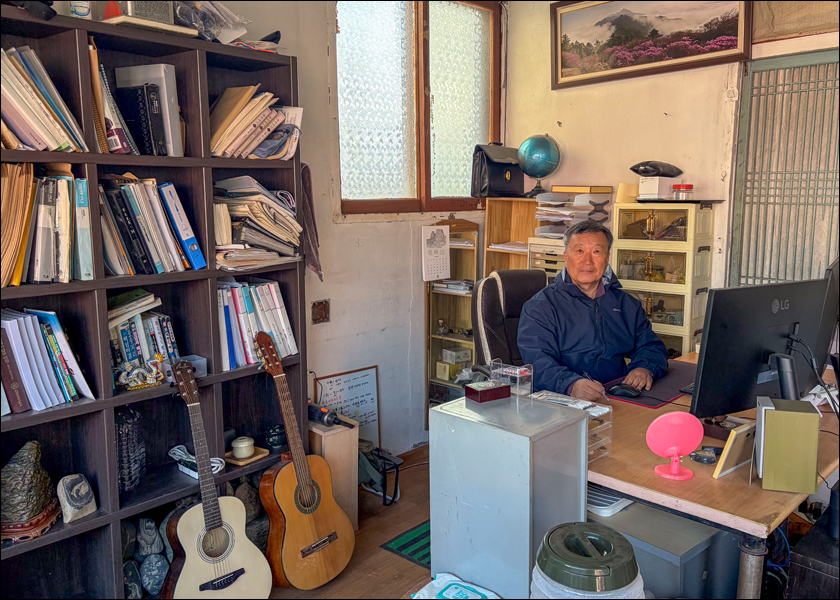
I drive him back to his small haeng jung sa (행정사, or government administrative attorney) office in Gokseong. He likes it there. It’s away from home, a place of his own. By now he’s pleasantly drunk. He tells me he will sleep in the back of his van, which is fitted out just for that purpose. Another quiet escape.
As I pull away, I roll down the window and make a slow U-turn into the shadowed side of the street. He is standing outside his little office, lit by the low spring sun. Calm. Slightly glowing.
I point at him and shout: “Nam-Buk Tongil!” It means “North and South Unite!”
He barely moves. Just looks at me, a smirk forming, and fires back:
“Ut-gyeo ”
Perfect usage.