
Making a big life change, one scholar learns the value of a new environment and the importance of mutual aid | By John Eperjesi (Summer 2026)
“Not till we are lost, in other words not till we have lost the world, do we begin to find ourselves, and realize where we are and the infinite extent of our relations.”
Henry David Thoreau, Walden
“You get lost out of a desire to be lost. But in the place called lost strange things are found.”
Rebecca Solnit, Field Guide to Getting Lost
In the summer of 2006, 20 years ago, I made an abrupt decision to move from Portland, Oregon, where I was an adjunct at Portland State University, to South Korea. The decision came as a shock to my mom. When I told her I was moving here, she didn’t say anything — we weren’t speaking to each other at the time — but I could see in her eyes that she was sad and scared. It was the same look I saw when I moved out of the house my senior year of high school because we were fighting so much.
My mom was an operating room nurse whose husband, my father, died of a heart attack at age 44, an event caused in part by genes, in part by the cigs and booze, and in part by his traumatic experience on the battlefield during the Korean War. Like most Americans, the image of Korea in my mom’s head came from the TV show MASH, which we watched at my grandma’s on Sundays before dinner. She lost her husband and now she felt like she was losing her son.
My decision to move here was abrupt, but my desire to leave the U.S. had been building for several years. In a word, I was beat. Rob Wilson explains that beat “means at one end of the journey being beaten-down, broken up, emptied out, beaten up by life and driven down and out by social forces and over-determinations.” I was beat down and driven out by the neoliberal university and George W. Bush.
I got my Ph.D. in the Literary and Cultural Theory program (LCT-RIP) at Carnegie Mellon University (CMU) in 2000, and published my book, The Imperialist Imaginary: Visions of Asia and the Pacific in American Culture, in 2005. But I didn’t have any luck on the job market. Every fall I excitedly sent out more than 100 applications, only to get a handful of interviews at the Modern Language Association (MLA) convention. Every spring I wondered what was wrong with me.
Tenure track jobs were, and still are, being replaced by adjunct positions in the neoliberal, “post-welfare state university,” as Jeffrey J. Williams names it. Added to that, my academic work was at the intersection of American Studies, Asian American Studies, and Transpacific Studies, or what is now called the Blue Humanities / Critical Ocean Studies. Back then, the oceanic turn in the humanities was underway, so I was working in a niche field, great for publishing, not great for getting invited into hotel rooms for interviews at the MLA.
My book was inspired in part by Rob Wilson, who was in the English Department at the University of Hawaii back then, before he moved to the University of California-Santa Cruz. I first discovered Rob’s work in 1994 when I stumbled on an academic journal called boundary 2, and saw a special issue entitled New Americanists 2: National Identities, Postnational Narratives, edited by Donald E. Pease. I was immediately drawn to Rob’s contribution, Techno-Euphoria and the Discourse of the American Sublime, which I expected to be about a style of electronic music that was born in Detroit in the 1980s.
The article isn’t about techno music but is a head-spinning synthesis of discourse about the sublime from the Hudson River School to cyberpunk, from the myth-symbol critics to postmodernism, all geared toward a critique of George Bush’s Patriot missile speech delivered during the 1991 Persian Gulf War. I was intoxicated by Wilson’s style of writing, which tripped me out. I remember thinking: This is the kind of work I want to do. At the time, I was considering doing my dissertation on hip hop. Fortunately, that didn’t happen. The last thing the world needed at that time was another white person writing about hip hop.
I immersed myself in the Asia-Pacific work of the boundary 2 collective, which to my surprise was headquartered in the Cathedral of Learning at the University of Pittsburgh, just across the street from CMU. I wrote a seminar paper, “The American Asiatic Association and the Imperialist Imaginary of the American Pacific,” that was published by boundary 2 in 2001, which was huge. I was told that this article would help me get a good job, so my expectations for success shot up, which made the fall that much harder.
In 2005 I finally left CMU and Pittsburgh, which was hard. Pittsburgh was home. I met a lot of amazing people through the art and music scenes and even converted from being a Rams fan to a devoted member Steeler Nation. But my life was a mess and I needed to leave. When I first moved to Pittsburgh for my MA in 1991, I took an Amtrak train across the country. Now, I was driving from Pittsburgh back to Portland to stay with my mom for what was supposed to be a short visit
Camilla Griggers, a professor in the Literary and Cultural Theory program before moving to California State University Channel Islands said she could probably find me a position in her program. I did a phone interview shortly after arriving in Portland, it went great and was told I got the job, but it fell through at the last minute.
I was stuck in Portland without a job and living with my mom, which was getting tense, just like high school. But a lifesaver stepped up in the form of Lee Medavoi, an old friend from the Marxist Literary Group (MLG), who was in the English Department at Portland State University (PSU). Lee helped me get an adjunct position. The position didn’t provide health insurance or a pension, but I was youngish. I figured I could worry about that stuff later. I was happy and grateful.
I had a couple more interviews at the MLA, but interviewers wanted to know what my next book was about. I was beat down and emptied out by the process of writing my book, and by moving across the country, and by teaching three or four courses a quarter. I didn’t have time to think about a new book, or about new research. I wasn’t writing anything.
One of the interviews at MLA was with Yonsei University in South Korea. I was excited about that interview, and that’s when I began to imagine living here. I knew about Korea primarily through teaching the film Shiri in my Transnational Asian Cinema class at CMU, and from knowing the Chan-wook Park film Sympathy for Lady Vengeance. Before I left Pittsburgh, I saw one of my favorite coming-of-age films, Take Care of My Cat. The dreamy soundtrack by Byul planted the emotional seeds of my desire to move here.
When teaching Shiri, I don’t remember if I came across the term hallyu, but I felt the Korea Wave coming and thought this might be a good time to move to South Korea. I didn’t get the job at Yonsei, but in my mind, my bags were already packed. After a short trip to Taipei and Tokyo in 2000, I realized I needed to live in a global city, not a small college town. Seoul was it. I would be following in Rob Wilson’s footsteps.
Rob first came to South Korea as a Fulbright Professor of American Literature in the English Department at Seoul National University (1982-1984) and spent one semester as a visiting professor in the English Department at Seoul National University in spring of 1984. And in 2004-2005, he was invited to be a Visiting Research Professor at Korea National University of the Arts by film scholar and director So-young Kim.
I didn’t know as much about Korean history or culture, or the Korean War, as I should have before moving here. But I did have an intense connection to Korea through my father. In the winter of 1952, my 18-year-old father entered the Korean War. After I read the 2nd Battalion, 1st Marines Command Diary and histories of the Marines in western Korea at the time, I hypothesized from what I knew of his war history, that he was probably involved in one of the many battles over Bunker Hill (Hill 122). When I saw Jang Hoon’s Korean War film The Front Line (2011), I got a sense of what my father experienced during the war.
On January 9, 1977, I watched my father, my best friend, die suddenly of a heart attack in the middle of the night. I was nine years old at the time, so I never got to ask him about the war, although I loved playing with his war memorabilia — medals, pins, bayonet, revolver — when I was growing up. It made me feel close to him. I later asked my mom if he ever talked about the war. She remembered him saying that when he was flying over to Korea, he knew he wasn’t coming back. Fortunately he did make it back, minus one body part.
Seven months after arriving in Korea, on September 5, 1952, my father was hit by missile fragments and received wounds to his thigh, buttocks, Achilles tendon, scalp, and face. He lost one of his testicles, but gained a Purple Heart. Because of his wounds, my father could not have children the old-fashioned way, so I was adopted, which means my destiny began to take shape the moment he was wounded in the Korean mountains.
I love going hiking here, and when I’m in the mountains I often tell people I’m looking for my father’s testicle.
Writing about Korean War literature and film, and about social movements to end the unending war, has helped me feel close to my father. I think his spirit might have guided me to this country, and helped me find a home here. I wanted to escape the U.S. empire, and ended up living in Gyungridan, a neighborhood that is next to a U.S. military base.
In the summer of 2006 I was an overworked and underpaid adjunct at Portland State. I was living in a hip city, and loved walking through the gorgeous Park Blocks on the way to class, but the future looked bleak. I was teaching a graduate course on Moby-Dick, and like Ishmael, felt beaten-down and broken up. It was a “a damp, drizzly November in my soul.” I was “tormented with an everlasting itch for things remote” as Ishmael says before he joins the crew of a whaling vessel and has wild adventures sailing around the Pacific.
On top of all that, lies about weapons of mass destruction were being used to justify the War on Terror, and the images of tortured prisoners at Abu Ghraib were horrifying. Seeing Bush, Cheney, and Rumsfeld in the news every day was making me sick. My mom had been seduced by Rush Limbaugh and Fox News. We had stopped talking to each other, just like high school.
All the signs were telling me that it was time to go, so at the end of the spring quarter I put my CV (a resume, or curriculum vitae, as they call it in academia) on Craig’s List for teaching English in South Korea. Within 24 hours, I had a job offer from an English academy (hagwon). Within a month, I went from teaching graduate students at PSU to teaching children in Korea.
The academy paid for my flight, set me up with an apartment, and loaned me money so I could get through the first month. I arrived in Seoul in August. It was rainy season – hot, humid, and very wet. My apartment wasn’t ready when I first arrived, so the school got a motel room for me. Walking through the hallway, there were DVDs on a shelf. Upon closer inspection, I noticed that they looked like soft core porn, which made me a little excited and very uncomfortable. What was going on here?
I later learned that this was a so-called love motel, a budget-friendly place to stay if you and your partner need some privacy or if you are traveling. The rooms usually come equipped with a water purifier machine, which is awesome, and a wide variety of hair products.
While teaching children at the academy, which was fun, rewarding, and exhausting in equal portions, I started applying for university jobs. When I went to interviews, some professors were suspicious. I got my Ph.D. from a prestigious university, published a book and several articles in top-ranked journals, so why was I in Korea teaching kids? One professor directly asked, “What’s wrong with you?” There was a lot wrong with me, but I didn’t have a criminal record, so everything was fine.
And for the record, I don’t think professors are more important, or higher up, than teachers at other levels. I say this because a couple of professors tried to shame me for teaching children when I got here. In my view, all teachers are equally important, from preschool to night school. One of the best experiences I’ve had in the classroom was teaching night school for adults at Carlow College in Pittsburgh. The obsession with status and hierarchy, both in Korea and everywhere, is toxic.
I got a full-time teaching gig in the General Education program at Kyung Hee University and finally had time to do some writing. I started tinkering with an article on the Wilkes Exploring Expedition that I started when I was at CMU. It was a huge archival project. I sent it to a couple journals before I left Pittsburgh, but it was rejected. I gave up on it when I moved to Portland.
But I polished it up and sent it to Amerasia. I received expert comments from all the reviewers, one of whom I later learned was Paul Lyons, who a University of Hawaii colleague of Rob Wilson’s in the era before he moved to Santa Cruz. I had read Paul’s work on American Pacificism but had never met him. He gave me helpful suggestions for revision and a solid list of books and articles to read that helped me pull the paper together. That publication helped me move to the School of English at Kyung Hee, where I would be teaching literature, finally.
I owed Paul a lot, so I was thrilled when he visited Seoul and I was able to invite him to our campus where he gave an inspiring talk on Moby-Dick. We had a wonderful time wandering and drinking around Hongdae. Paul tragically passed away in 2018. He was a legend in the classroom, on the basketball court, and in the pool hall, and is deeply missed by people all over this watery world.
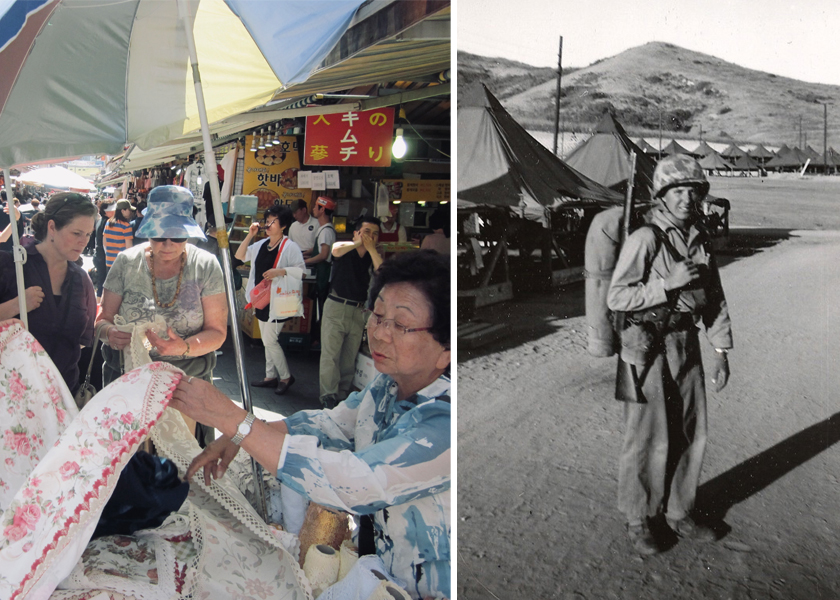
After moving here, my mom didn’t lose me; in fact, we became very close. Absence most definitely made our hearts grow fonder. In 2014, my mom and sister visited, and we had a blast wandering around the city, especially Namdaemun Market and Myeong-dong Cathedral. Their visit was one of the highlights of the past 20 years. She was happy I found a home here. My mom passed away in 2020, during the pandemic, and year later, I got tenure.
Since the pandemic, the most important keyword in my classrooms, in my work, and in my life, is mutual aid. If there is a moral to the story above, it is that academia, at its best, can be a mutual aid network that helps people get through hard times. Education, now more than ever, is “survival work,” as Dean Spade calls it.
In 2006, I was beat. Now, in 2026, like many of us, I’m feeling beaten up by the climate emergency, genocide, Trump, but occasionally, I glimpse the other side of beat – beatitude -which Rob describes as the “transformative energies generated from this double sense of happy/holy and ready to make self and world anew.”

