
Sangjaru imaginatively blends Korean traditional music with Western jazz, pop and rock for fun, crowd-pleasing results | By Martha Vickery (Summer 2026)
Achieving success with fusion, whether in fashion, cuisine or music, is a little like learning to ride a bicycle. On either side, there is certain disaster, and the narrow path of success is balanced in the center.
In terms of fusion music, success looks like creating a way between something too familiar, which does not sound like fusion at all, and something so unfamiliar that the audience loses interest. The magic is in the balance.
Making fusion art also requires attacking the challenge with some speed, and perhaps, some big confidence. No one ever learned to ride a bike by going slowly.
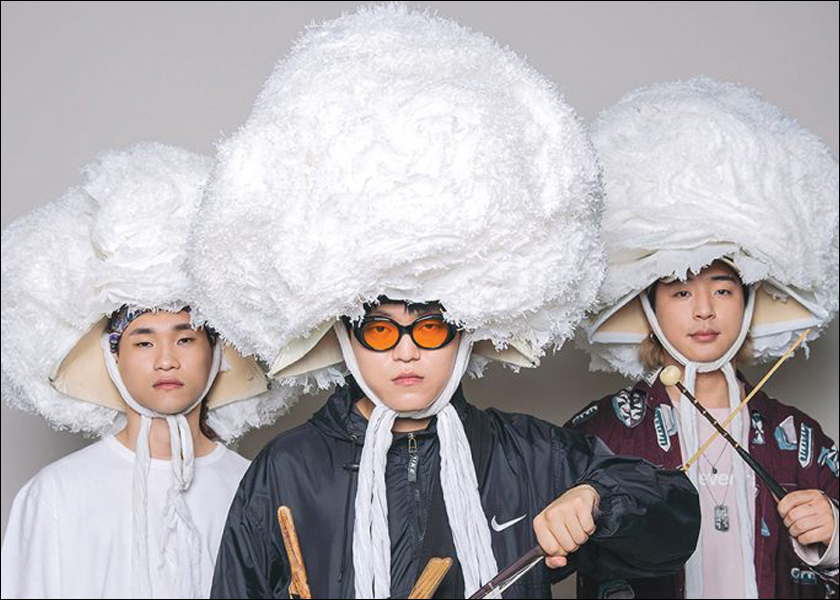
For the Korean gypsy funk fusion band Sangjaru, which will have its Minnesota debut on September 30 at the Cedar Cultural Center in Minneapolis, that big confidence is symbolized by some very big hats.
Audiences are delighted by the humor (including the traditional hats), the energy, and the eclectic styles of music that unroll when this three-person group gets playing.
As Sangjaru discovered in a previous U.S. tour, a general audience happily shows up, and is excited by the driving Korean-style percussion, the sawing sound of the ajaeng (traditional zither), the Korean sounds coming out of a guitar, and the lilted traditional singing. Sangjaru also treats their audiences to plenty of funky beats, with some lighthearted humor, play, and clever crossover of Korean and American popular music styles.
It is the kind of show that is fun for anyone open to something new, but with deep enough roots in Korean traditional sounds that a musicologist would be curious to dig into it.
A theory about a box and a sack
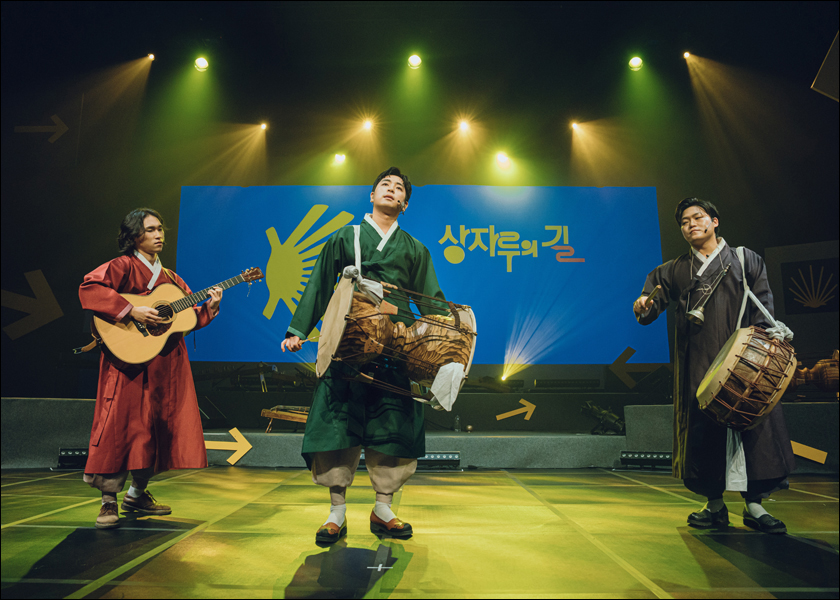
The concept for Sangjaru was invented by the three members in a college dorm room back in 2014, explained Sungyun Cho, the composer, guitarist, and player of other assorted instruments, through a written interview. “So by now, we’ve spent most of our lives inside each other’s music.”
Each of the three brought his own pedigree in Korean traditional music – all had been to the National Gugak High School and the Korea National University of Arts. Both institutions are dedicated to preserving Korean traditional performing arts. “My proposal was that we begin as a study group, and if it felt right, become a band. That conversation turned into Sangjaru.” The group discussed, composed, and played together, but did not officially debut until 2019.
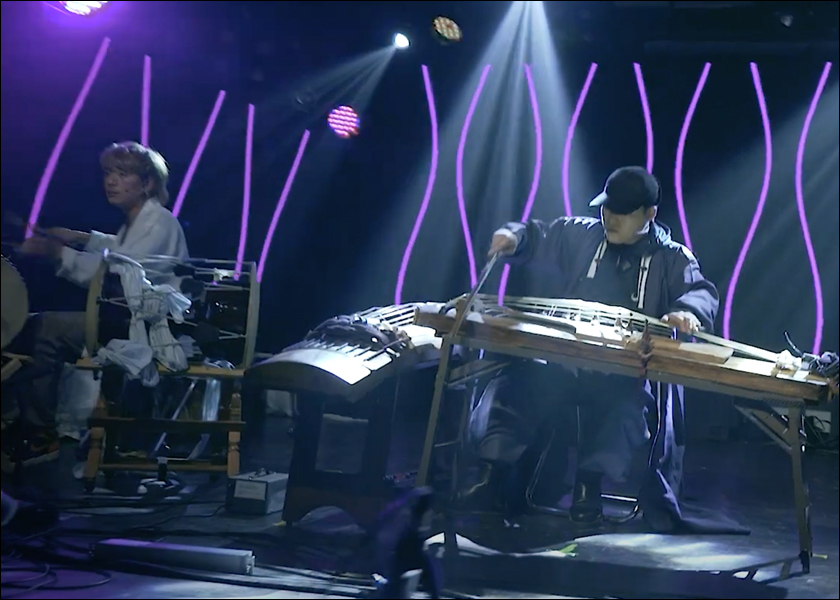
The other two band members are: Hyochang Kwon on the gwaenggwari (handheld cymbal), and the janggu (hourglass-shaped drum); and Seonghun Nam on the aejaeng (one of several types of Korean zither), and taepyeongso (a reed instrument, often played during drum performances).
In Korean, the word for “box” is sangja, and the word for “sack” is jaru. “The name came out of a theory we were discussing around that time,” Cho explained. “The rigid structure of a box is more like the repertoire in what is known as court music and other classical music,” a style called jeongak in Korea. Jeongak is “largely ceremonial music, expressing Confucian thought, so artistic freedom isn’t what matters in it,” he added.
A sack (jaru) also has a particular structure “but its shape changes depending on what you put inside,” he said, which makes it more like folk music, or minsogak. Folk music, he said, “is an art made among ordinary people, so that freedom shows up in a way it doesn’t in court music.”
The group thought about how they would interpret, as a band, both the history of Korean music and their place in it. “The more we talked, the closer we got to a version of our own,” Cho remarked. “For three people living in the 21st century, the box could be tradition, and the sack could be our own contemporary experience. Sangja and jaru share the syllable ja, so we joined them right there – Sangjaru.”
Between 2014 and 2019, there were a few other groups headed in the direction of Sangjaru, using Korean rhythms to inject new energy into rock, pop, funk and rap music. Sangjaru, due to the unique musical backgrounds of its members, was the first to fit together its particular combination of Korean traditional performance style (yeonhui), folk music (minsogak), and the sounds of the aejaeng – sometimes harsh, sometimes violin-like — into original compositions. It was “a first of its kind,” he said. “It wasn’t planned. It just happened to be who the three of us are.”
In a Sangjaru concert, the audience might hear something that sounds like a Texas Two-Step or swing music piece, where the gwaenggwari (small cymbal) played by Kwon stands in for percussion, accompanied by a scratchy baritone violin sound (the aejaeng) by Nam, along with Cho’s fast-strumming guitar.
In another piece, there may be a moody and mysterious guitar solo that becomes a slow ballad-like version of the traditional Arirang song as the other instruments come in to create layers of music and meaning.
Other pieces sound a bit like unplugged progressive jazz. Nam coaxes cool jazzy riffs out of his aejaeng, sawing away at it at lap level with a giant bow, convincing us the instrument was absolutely created for a jazz band.
All the players sing catchy folk songs, occasionally speak or even recite poetry. Sometimes, there is a guest singer. At least one song, Byeoldalgeori, is a recitation of percussion beats that sounds a little like a jazz scat. Such recitation is also a piece of tradition; each beat type has a name in Korean percussion. Singing the gu-eum (the names of the beats)is a kind of mnemonic device Korean drum players use to memorize the piece, and the audience gets to hear a sample of it in the Byeoldalgeori arrangement.
Sangjaru also plays some original rock pieces mixed with Korean folk song patterns, so catchy that you want to get out on the dance floor.
Korean music – back to basics
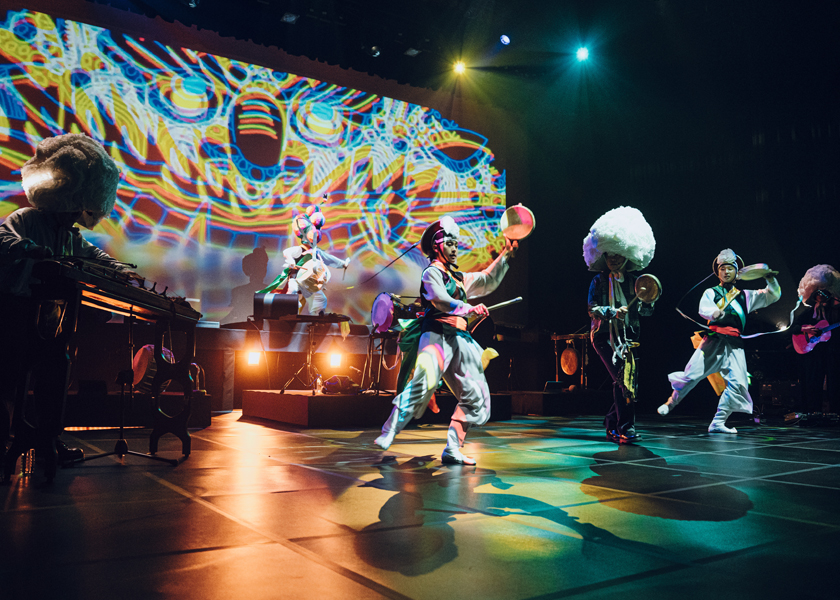
Korean traditional music forms, particularly traditional percussion compositions, are characterized by beats that start out soft, slow and simple and build slowly to something loud, hard-driving and complex, often with an abrupt ending. Sangjaru capitalizes on this performance technique in its compositions, often building complexity, adding on patterns and notes, increasing speed and volume, while persuading the listener into a kind of musical hypnosis, until the piece comes to a sudden and satisfying finish.
Cho noted that the three traditions of Korean music they embrace are “quite far apart” from one another in the spectrum of styles that is Korean music. “Yeonhui [Korean traditional folk performance] is percussion-centered performance music, rooted in what ordinary people played,” he said. The ajaeng (zither), in contrast, “generally belongs to music performed for the middle and upper classes and at court.” Overlaying that is the group’s compositional technique, which is definitely contemporary, Cho said. “So this band was made by three people who really were trained on different paths.”
Cho said he studied the most compositioin “so I do write the most, but I’m not the only one writing. One of the principles I raised in that first dorm-room conversation was that the band should never be saturated by a single person’s musical color. So Hyochang and Seonghun bring in their own pieces too, and some of our music is built by all three of us from the very start.”
There are no rules, per se, but there are characteristics of traditional music to be preserved if the end product needs to look like fusion, Cho believes. “Our rule for a long time was to avoid dismantling a traditional element as much as possible.” As a rough comparison, he said, if you are taking a cup completely apart “and then, while putting it back together, pour in so much creative force that it becomes a business card holder, then it’s a business card holder.”
To avoid losing the original cup, Cho explained, when Sangjaru reimagines Korean traditional sounds and patterns, “we bring it over whole, in a standardized form, and lay our own work on top of it.” They want any Korean traditional music lover to recognize what it is. They also want a general listener to hear it as familiar enough, but to perceive the Korean traditional elements within it.
Over the mountain, they do it differently
These days, South Korea is one of the most modern countries in terms of its communications network and transportation hub. But for most of its history, Korea was a land of impossibly high mountains with few good roads linking habitable areas.
“Performance style differs by region as well, and by genre on top of that. We were taught that these differences developed because in the Joseon era, before modern transportation, you had to cross high mountains to get anywhere, so cultures formed separately and then reinforced themselves,” Cho explained.
The topographic challenges of that past means that modern Korean composers of fusion music have a rich repertoire from which to choose their inspiration.
“Honestly, it comes down to whatever grabs us in that moment,” he said. Influences from Korea are many, from rural percussion forms (nongak) to folk songs with unique time signatures. There are many Western influences too. In a boppy piece called Gyeongbok Swing, the group was inspired by Mueul Nongak, an ancient performance style from Gyeongsang province, along with the classical jazz guitarist Django Reinhardt’s piece Minor Swing.
Concerning the hats
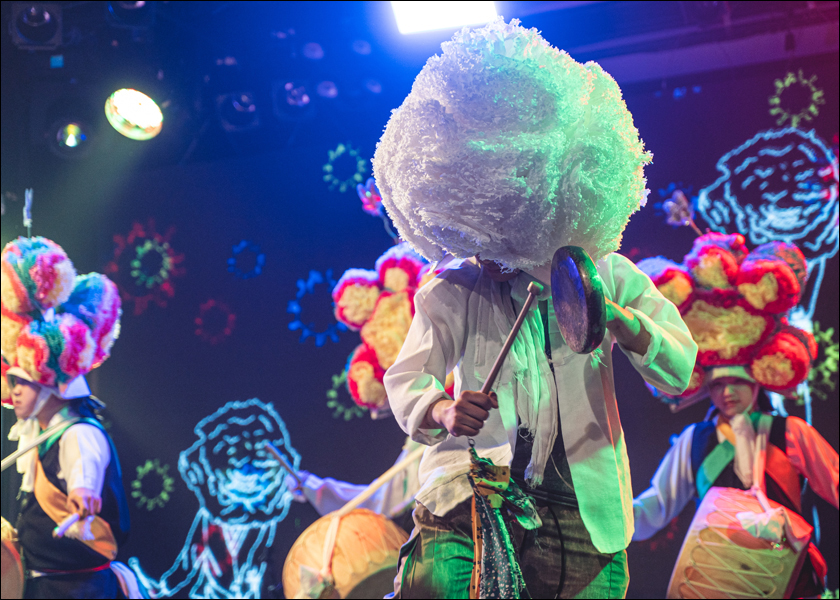
The signature white hats that make the guys look like pom-poms on steroids are inspired by the traditional dress of the Mueul Nongak drummers. Cho said Sangjaru wear their giant hats only for the two pieces inspired by Mueul Nongak — Jisin RV and Gyeongbuk Swing. “Partly we want the image of nongak to come across more strongly to the audience, and partly because when we play those pieces we feel we’re playing our own nongak.”
“We’re bringing the hats on this tour as well,” Cho added. “They’re so bulky that flying them over would cost an enormous amount, so we make them all again by hand once we get to the United States.” Percussionist Hyochang Kwon is always the one who conceives and handles our stage costumes, he said.
The Korean gypsies
The band was once known as “Korean Gipsy Sangjaru,” according to Cho. They used the word “gipsy” to suggest their band’s way of life, “traveling and taking in the culture of each place you pass through,” Cho said. But “because of that name, people increasingly assumed we were a gypsy jazz band, and interviewers kept trying to tie us to gypsy jazz.”
At one point, he said, “we thought ‘fine, let’s make a piece with a gypsy jazz grain to it as well.’ That’s where it came from.” Reinhardt, who wrote Minor Swing, was of Romani ethnicity, and a master composer. He created some pieces in the gypsy jazz style. Sangjaru’s Gyeongbok Swing is, in part, its homage to Reinhardt and his gypsy jazz.
It was apparently a decision based on ‘if you can’t beat ‘em, join ‘em.” The word definitely sparks curiosity, and they still use the words “gipsy” and “gipsy jazz” on some of their promotional material.
A breakout moment for Korean funky fusion
Understandably, music reviewers continually try to generalize about Sangjaru’s musical genre, which is difficult, given their adaptability to so many different styles. How do they compare themselves with other Korean bands that are incorporating traditional music? “We get asked it all the time,” he reflected, “and the more we focus on it, the more our freedom to create seems to slip away, because we end up concentrating on the difference instead of the music.”
The Sangjaru signature sound is recognizable by “the density of musical energy that a small number of players can generate,” he offered. “Come to a show and you’ll feel it right away.”
K-pop bands have broken into the popular consciousness in the U.S., and have perhaps helped with U.S. audience acceptance of anything called “Korean music.” But more touring by all types of Korean bands in recent years has helped too.
Sangjaru has been performing in the U.S. regularly since last year, through a New York management group called Sori Artist, which contracts with other groups offering Korean fusion music incorporating Korean traditional music and performing arts. Originally, Sori booked band tours just in New York state, but “it has become a tour that reaches more widely across the country,” Cho said.
When they first toured in the U.S., Cho said, audiences immediately showed up and liked them even though they had no idea who they were, or where the music came from. “What’s changed recently is that the word gugak [a general term for Korean traditional music] has moved from indifference to at least recognition,” Cho observed.
For this tour, Sangjaru is working on an album and some new pieces to bring with them, Cho said. They are all looking forward to the U.S. tour. “We really love American audiences. They don’t seem to lock us inside a frame like ‘gugak’ or ‘world music.’ It feels like they’ve simply come to enjoy a culture, an art. It’s always been that way,” Cho said, “and they’re the most active, the most energetic, the kindest. Who are we to target anyone? We just prepare so that the hour someone gave us, and whatever comes after it, leaves them with no regrets.”
Tickets for An Evening with Sangjaru are at the Cedar Cultural Center box office, at this link

