Miss Kathi: Saving Lives in North Korea ~ By Kathi Zellweger and Mike Chinoy
(Post Hill Press, New York, 2026, ISBN #979-8-8956-5671-6)
Review by John Feffer (Fall 2026)
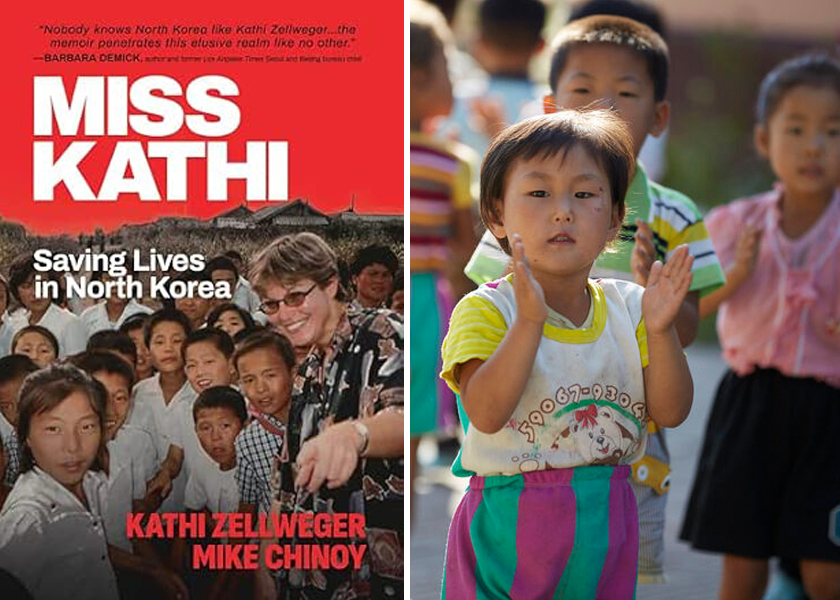
For everyone who has worked in and around North Korea, Kathi Zellweger has been a role model. As the director of international operations at the Catholic charity Caritas, she oversaw food aid to North Korea in the 1990s when it was overwhelmed by famine. Later, she worked in Pyongyang for the Swiss government on various development projects. When that assignment ended, she continued to remain engaged through an NGO she founded to provide the supplies needed for cataract operations in North Korea. Throughout this challenging work, she remained unfailingly dedicated. Even as other international organizations withdrew from North Korea and the government there put restrictions on those that remained, Zellweger still focused on helping the most vulnerable people.
She also provided, quietly, a steady stream of information about what was going on in one of the most secretive states in the world. When my wife and I worked in Northeast Asia for the American Friends Service Committee, we met with Kathi Zellweger several times at her Hong Kong office and also received her regular clippings of North Korea-related articles. It was such a relief to meet with her. People who work on North Korean issues often fall into two categories: Cynical observers or fellow travelers who inexplicably believe in North Korean ideology. Zellweger was neither. She was practical, clear-eyed about the nature of the system, but also hopeful about how outside assistance could improve the lives of everyday North Koreans.
What was once available only to those in Kathi Zellweger’s network is now available to everyone, thanks to a new book, Miss Kathi, that she has written with longtime journalist Mike Chinoy. It chronicles her experiences in North Korea across 75 trips, from her first contact in 1995, just prior to the outbreak of famine, to her last, pre-pandemic visit to the country in December 2019. The book also details her five years of living inside North Korea as a representative of the Swiss government’s official development agency.
The most dramatic descriptions in the book concern the famine years. The North Korean state was reluctant to provide an accurate picture of what was happening inside the country for fear that it would prove the system wasn’t working. Because of a fear of outside military intervention, the government believed that it had to project strength, not weakness.
But North Korea also needed help. The increase in the cost of energy, after both Russia and China stopped providing fossil fuels at concessionary rates at the end of the Cold War, put heavily mechanized North Korean agriculture into a perilous state. Tractors were now useless, and chemical fertilizer had become too expensive. Several natural disasters — heavy rains, drought — pushed the system over the edge.
Since she was already known and to a certain extent trusted, the North Korean authorities showed Zellweger the extent of the starvation. At a pediatric hospital she visited in September 1998, for instance, “were dozens of kids, weak, emaciated, with stick-like limbs and eyes that haunted me — the hollow, staring eyes of malnourished children.” Such scenes motivated her to issue international appeals through Caritas that brought in millions of dollars of food aid.
It just so happens that my wife and I also visited North Korea for the first time in September 1998 to explore the possibility of exchanges with the U.S. and other countries. We were not brought to the scenes that Kathi Zellweger witnessed. Instead, we visited various government offices. We were taken to restaurants where our driver, minder, and translator ordered a lot of food — and took some of it home, presumably to their families — and attended a banquet that our organization had to pay for. We visited a farm that presented us with a lunch of many dishes. We knew of the famine, and it was very difficult to eat anything.
And yet, the only sign of malnutrition that we saw was in the two children begging for cigarettes near our hotel. Two British insurance claims adjustors that we met at the hotel told us not to believe in the reports of hunger, that the only sign of privation they saw in the villages was the substitution of goat for beef in the bulgogi. To the contrary, Zellweger’s reports dispelled any notion that the North Korean government was faking it. The fact that my wife and I saw no evidence of famine, and instead received the royal treatment during our visit, meant only that we were not trustworthy. Later, in subsequent trips to the country, we were able to glimpse some of the terrible impact of the humanitarian disaster.
It was not an easy assignment to work with North Korea. The government is thoroughly autocratic. It has one of the worst human rights records in the world. And it has long pursued — and eventually achieved — membership in the nuclear club. For many, these characteristics have disqualified North Korea as worthy of engagement. But Zellweger has maintained a clear moral position: “My own view was that allowing North Koreans to starve because of distaste for the country’s political system was morally wrong. It was not the fault of the children we were trying to feed that they had been born in North Korea.”
This ethos carried over to her post-famine work. When the North Korean government restricted outside engagement to development work — as opposed to the provision of humanitarian aid — Zellweger continued to develop programs that met the new criteria. Those programs helped farmers develop new and more productive crops and trained young professionals in contemporary business practices. As North Korea shifted to a market economy, the government relied on outsiders to provide it with training in banking, finance, and entrepreneurship. Zellweger connected North Koreans to Chinese MBAs and Swiss training opportunities.
As money became more of an organizing principle in North Korean society, Zellweger both helped train those who were engineering the transition to a market economy and observed the widening gap between rich and poor.
The signs of these changes in society were increasingly evident to me on the streets of Pyongyang. People patronized the growing number of restaurants, not just the Italian pizza place where I had taken my team but many others, including a Singaporean-run hamburger joint and a Viennese café where they could sip cappuccinos while admiring the broad vistas of Kim Il Sung Square, all the while paying with stacks of U.S. dollars or euros. The women would make a point of displaying their jewelry in public, including fine gold chains or fashion from Beijing’s Zara and H&M stores, while the men, often wearing Adidas or Nike sneakers, would smoke expensive imported cigarettes. I could see a growing number of cars on the roads as well as taxis — a half dozen new taxi companies were now operating — but still, the normal way of getting around was by bus, train, subway, bicycle, or what was known as “bus number eleven,” the two ones in the number referring to people’s two legs as they walked and walked and walked.
But as Miss Kathi demonstrates, her heart remained with the most disadvantaged segments of North Korean society. She was one of the first outsiders to work on improving the status of the disabled in North Korea. “In a society so short of resources, I had long felt that disabled people were at the bottom of the priority list, often rejected or marginalized, with few support facilities, so I was always looking for opportunities to raise the issue or find ways to encourage the North Koreans to focus more attention on it,” she writes. As a result of these efforts, and connections to such organizations as Handicapped International, North Koreans could finally take advantage of vocational training. Some ultimately trained for the Paralympics. A semi-independent civil society organization even emerged through which the disabled could voice their concerns.
Miss Kathi sometimes reads like an extended NGO report, the first half designed to raise money for relief efforts and the second half an extended plea to support development projects. But the book contains many fascinating observations about the changes taking place in a relatively cloistered society. Zellweger describes the increasingly prominent role of women in North Korea because of their involvement in market activities (while their husbands still have to report to their official workplaces). She reports on the hardworking professionals — doctors, teachers — who are determined to do their jobs under very difficult circumstances. She takes us inside the tiny world of expats living in Pyongyang, provides glimpses of the lives of her North Korean staff at the Swiss development agency, and offers some details about the North Korean workers at the short-lived Kaesong Industrial Complex who worked under the supervision of South Korean managers.
North Korea shut its borders when COVID-19 hit. Today, tourism remains limited. Embassies have reopened in Pyongyang but the expat community is even smaller than it was during the time that Kathi Zellweger worked there. Diplomatic engagement between North and South Korea has withered and, aside from Donald Trump’s affection for North Korean leader Jong Il Kim, there isn’t much contact between Pyongyang and Washington either.
Now on the outside looking at a country that has again become opaque to foreigners, she remains determined to help those in need and humanize North Koreans for those who still view them as little more than automatons. “While I had no choice but to deal with the system as it was, with all of its oppressiveness and idiosyncrasies — and no question, the system imposed severe constraints on foreigners — my ongoing involvement, which included visiting every province as well as many places other outsiders were not allowed to go, gave me a sense of North Korea as a living, breathing society of twenty-four million individual people, each with his or her own hopes, fears, and aspirations,” she writes.
Kathi Zellweger worked hard over several decades to keep many of those 24 million people alive. Her memoir Miss Kathi now helps to make North Korea come alive.